
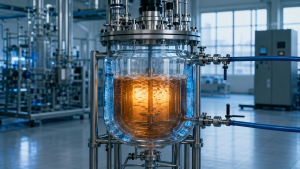
Thermal Safety by Design: How Jacket Geometry and Emergency Cooling Circuits Should Be Specified for Exothermic Scale-Up in Glass Reactors
At pilot scale, an exothermic reaction can produce heat faster than a reactor can remove it, because reaction heat grows…

Low-Temperature Glass Reactor Setups for Process Development
Low-temperature reactor performance depends on the complete setup, including vessel design, cooling source, insulation, stirring, sensor placement, and dosing path.…

Benefits of Using Jacketed Glass Reactors for Temperature-Sensitive Processes
A jacketed glass reactor uses a heat-transfer fluid circulating through an external thermal jacket to provide indirect, controlled heating or…
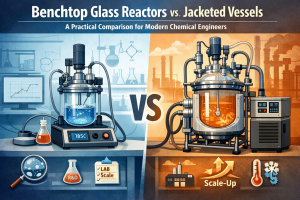
Benchtop Glass Reactors vs. Jacketed Vessels: A Practical Comparison for Modern Chemical Engineers
Benchtop glass reactors suit development, screening, and teaching where a compact setup, visibility, and adjustable agitation and temperature are important.…

How to Achieve Precise Temperature Control in Laboratory Glass Reactors
Precise temperature control means regulating the actual reaction temperature accurately and reproducibly under real laboratory conditions. It depends on system…

How to Integrate a Glass Reactor with a Digital Temperature Controller (Without Losing Control)
A digital temperature controller works as part of a closed-loop system: the measured temperature regulates heating or cooling through the…
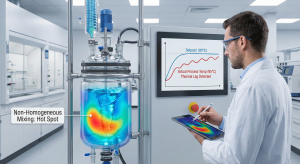
Troubleshooting Temperature Control: Mastering Thermal Lag and Hot Spots in Glass Reactors
In precision chemistry, temperature isn’t just a variable; it’s the conductor of the entire orchestra. When processes drift, troubleshooting temperature…