
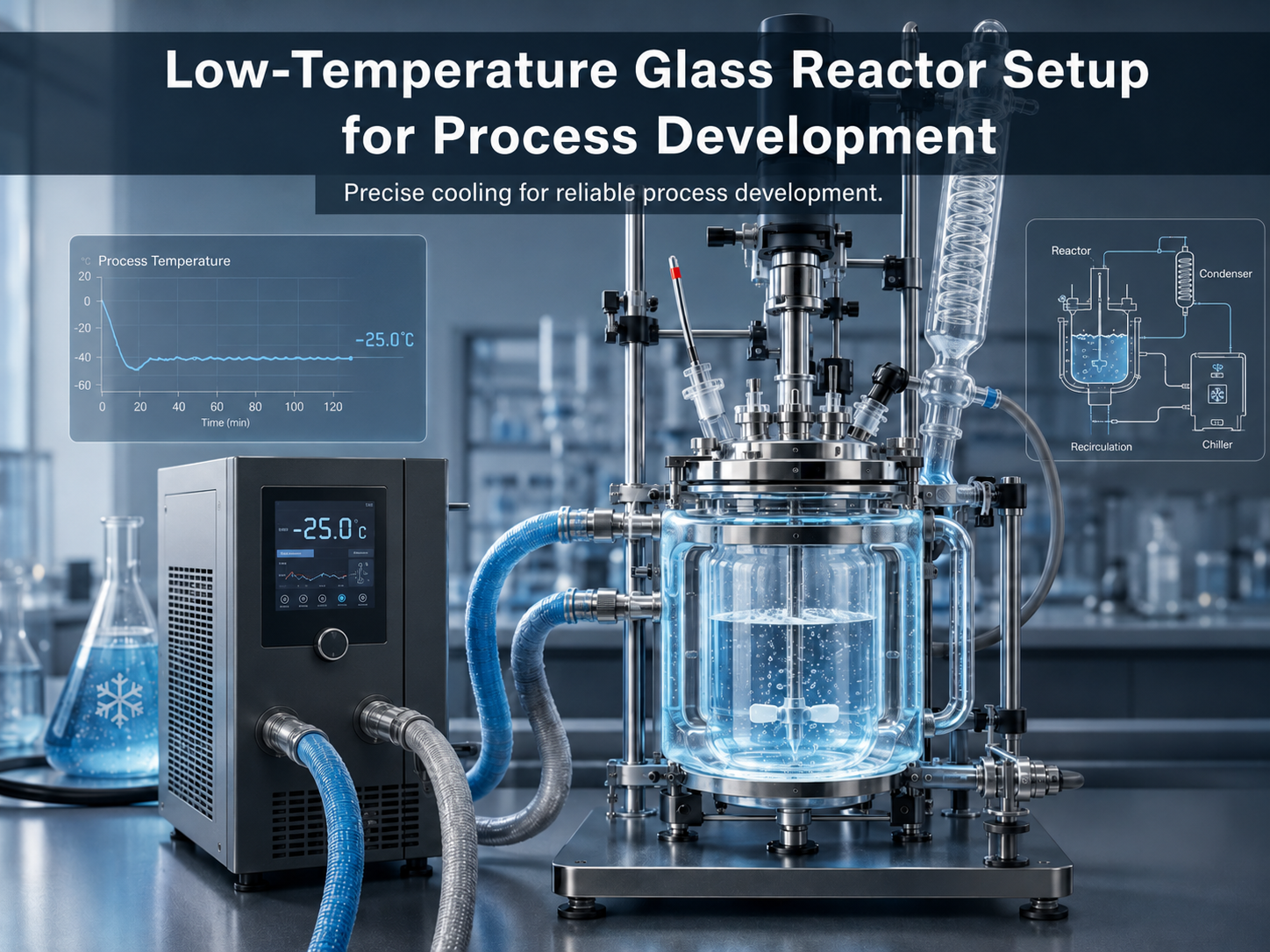
Key takeaways
- Low-temperature reactor performance depends on the full setup: vessel design, cooling source, thermal insulation, stirring, sensor placement, dosing path and operator safety.
- The process temperature is more important than the chiller setpoint. A reliable setup measures and controls the reaction mass, not only the jacket.
- Frost, condensation and ice on the vessel are not minor inconveniences. They reduce visibility, introduce handling risk and can hide process changes.
- Triple-walled or evacuated vessel designs may be useful for very cold work, but the correct choice depends on the required temperature range, batch size, heat load and observation needs.
- A good specification gives the equipment manufacturer enough information to check feasibility instead of forcing the lab to adapt chemistry around a standard apparatus.
Introduction
Low-temperature chemistry often starts with a simple instruction in the method: cool to -20 °C, dose slowly, keep below -10 °C, then warm to room temperature. On a small flask, that may be possible with an ice bath, dry ice bath or compact circulator. During process development, the same instruction becomes a system problem.
The batch is larger. Addition takes longer. The heat release is harder to remove. Stirring becomes more important. The vessel may frost over. Sampling, dosing and documentation are no longer optional. If the setup was specified only by target temperature, the laboratory may discover too late that the process temperature is unstable, visibility is poor or the dosing port layout does not match the real workflow.
This article explains how to specify a low-temperature glass reactor setup for laboratory and kilo-lab process development. The focus is practical: what the chemist, process engineer, lab manager or distributor should define before asking for a quotation.
What makes low-temperature reactor work different?
Low-temperature reactor work is different because heat transfer, mixing, condensation and safety constraints become part of the chemistry. The reactor must not only reach a cold setpoint. It must hold the reaction mass within an acceptable range while reagents are added, solids form, viscosity changes and operators still need visual access to the process.
Common low-temperature applications include:
- temperature-sensitive synthesis
- exothermic reagent addition
- selectivity control in organometallic or catalytic reactions
- crystallization or precipitation at controlled temperature
- polymerization or quench steps where heat release must be managed
- moisture-sensitive or oxygen-sensitive processes requiring closed handling
The central question is not simply “How cold can the system go?” A better question is:
Can this exact setup maintain the required process temperature under the expected heat load, with the required stirring, dosing, visibility and safety controls?
That question changes the specification.
Define the process requirement before selecting hardware
The cooling device and reactor vessel should be selected from the process requirement, not the other way around. Before choosing a vessel or cooling method, define the operating case that the system must handle.
Useful specification inputs include:
- target process temperature and acceptable deviation
- starting temperature and desired cooling ramp
- batch volume and working volume range
- solvent system and freezing or viscosity behavior
- expected heat of addition or reaction
- dosing rate and addition duration
- whether solids, slurries or crystals form
- stirring requirement and viscosity range
- atmosphere requirement, such as inert gas or dry gas blanketing
- sampling requirement during the cold phase
- required visibility into the vessel
- fume hood, floor stand or enclosure constraints
- cleaning, draining and changeover needs
- documentation and process transfer requirements
This information lets the equipment manufacturer check whether a standard jacketed setup is realistic, whether a modified vessel is needed, or whether a more specialized low-temperature arrangement should be considered.
Main setup options for low-temperature work
Several reactor configurations can support low-temperature laboratory work. The right option depends on temperature range, heat load, batch size, visibility needs and procurement budget.
| Setup option | Typical use case | Stärken | Limitations to check |
|---|---|---|---|
| Jacketed glass reactor with circulator | Moderate low-temperature reactions and controlled cooling | Familiar setup, good process visibility, flexible reactor head layout | Cooling capacity, thermal fluid viscosity, hose insulation, achievable process temperature |
| Triple-walled or evacuated glass vessel | Very cold work where frost control and visibility matter | Better insulation, reduced external condensation, improved observation during cold operation | More complex design, vessel availability, cleaning and handling requirements |
| Cold-gas cooling concept | Applications requiring strong low-temperature cooling without circulating liquid in the jacket | Fast cooling potential for suitable systems, avoids some thermal-fluid limitations | Nitrogen supply, ventilation, oxygen-displacement risk, system-specific design review |
| External bath or simple cooling bath | Early screening, very small scale, simple chemistry | Low cost, simple setup | Poor transferability, limited control, poor documentation, difficult scale-up |
| Metal or pressure-rated reactor | Processes needing pressure capability or higher mechanical robustness | Can address pressure or demanding mechanical requirements | Reduced visibility, different cleaning and compatibility considerations |
For HWS applications, the discussion usually begins with glass reactor systems, jacketed or special vessel designs, suitable stirring and sealing, temperature measurement and any required custom head layout. If the process requires pressure operation, the requirement must be stated clearly and reviewed separately. Standard flat-flange glass reactor setups should not be treated as pressure reactors unless a specific configuration has been designed for that duty.
Why process temperature matters more than jacket temperature
The jacket temperature is not the reaction temperature. At low temperatures, this distinction becomes critical because glass, thermal fluid, wall films, viscosity and mixing all add delay between the cooling source and the reaction mass.
A circulator may report -40 °C while the process sits at -24 °C. During reagent addition, the process may climb faster than the jacket can remove heat. In a slurry, the probe may read one region while another region near the wall or dosing point behaves differently.
For process development, specify:
- where the temperature probe should sit in the reaction mass
- whether the controller should regulate jacket temperature or internal process temperature
- whether an additional jacket outlet or wall measurement is useful
- acceptable overshoot during cooling and addition
- alarm behavior for high temperature, low temperature or sensor fault
- how temperature data should be recorded for process transfer
HWS can integrate PT100 probes, laboratory controllers and compatible vessel/head layouts where the process requires more than a basic thermometer port. The final design should be matched to the selected reactor volume, stirrer geometry and port arrangement.
Cooling method: circulator, cold gas or special design?
The cooling method should be selected by the required process temperature and heat load. A low setpoint on a brochure does not guarantee that the reaction mass will reach or hold that temperature under real operating conditions.
Circulator-based cooling
Circulator-based cooling is common because it is familiar, controllable and compatible with jacketed glass vessels. It works well when the thermal fluid remains pumpable, the cooling capacity is sufficient and the reactor jacket provides enough heat-transfer area.
Key questions:
- Is the thermal fluid suitable for the lowest operating temperature?
- Does viscosity increase so much that flow through the jacket becomes poor?
- Are hoses, fittings and jacket connections insulated?
- Is the circulator sized for the batch volume and heat load?
- Will the process be controlled from the internal probe or the circulator outlet?
Cold-gas cooling
Cold-gas concepts can be useful where very low temperatures are required and liquid thermal fluids become limiting. HWS catalogue knowledge includes the Coolgas COGA’N system for low-temperature reaction vessels. The practical value is application-dependent: nitrogen supply, ventilation, oxygen monitoring, exhaust handling and operator procedures must be reviewed for the specific laboratory.
Key questions:
- What temperature range and ramp are truly required?
- How will cold gas be supplied, controlled and exhausted?
- Is the laboratory ventilation suitable?
- Is oxygen displacement risk addressed?
- How will frost and condensation be managed?
- How will the setup be cleaned and prepared between campaigns?
Special vessel design
For very cold work, vessel design may matter as much as the cooling unit. Triple-walled or evacuated vessels can help reduce heat gain from the room and improve visibility by reducing external condensation. They are especially relevant when visual observation of crystallization, phase separation, gas evolution or fouling is part of the workflow.
The trade-off is complexity. The specification should confirm volume, vessel geometry, bottom outlet requirements, head layout, support frame, cleaning method and any limitations from the vessel design.
Vessel geometry and insulation choices
Low-temperature performance is shaped by geometry. A tall narrow vessel, a wide flat-bottom vessel and a conical vessel do not behave the same way during cooling, stirring, crystallization or draining.
Important vessel questions include:
- Is the process a liquid reaction, slurry, crystallization or precipitation?
- Does the batch need complete drainage while cold?
- Will solids settle near the outlet?
- Is a bottom outlet required, and if so, can the valve design tolerate the temperature profile?
- Is a cylindrical, conical or short-form vessel more suitable?
- Is frost-free visibility important throughout the batch?
- Does the vessel need baffles or a specific stirrer position to improve heat transfer?
At low temperatures, the bottom outlet and drain path deserve special attention. A valve that works well at room temperature may behave differently when the process liquid is cold, viscous or crystallizing. If a bottom outlet is needed, specify whether the reactor will be drained cold, warmed first, filtered downstream or transferred under inert gas.
Stirring, viscosity and heat transfer
Stirring is part of the cooling system. In glass reactors, heat must move through the glass wall and then through the reaction mass. If the liquid near the wall is stagnant, cooling becomes slow and uneven.
The stirrer should be selected for the real process state:
- low-viscosity solution
- two-phase mixture
- slurry
- crystallizing batch
- viscous solution at low temperature
- solids addition into a cold liquid
An anchor stirrer may be useful for wall sweeping and higher viscosity, while propeller or turbine geometries may improve axial flow or turbulence in lower-viscosity systems. The best choice depends on vessel geometry, volume, viscosity, solids content and heat-transfer requirement.
Also consider the seal and drive. Cold operation can combine torque changes, vapor containment, inerting needs and condensation around upper components. If the process requires gas-tight or vacuum-capable stirring, that must be stated during specification rather than added after the reactor head is already fixed.
Dosing into a cold reactor
Dosing is often the moment when a low-temperature setup is tested most severely. Adding a reagent can release heat, change viscosity, create solids, shift pH, introduce moisture or overwhelm local mixing near the inlet.
A good low-temperature reactor specification should define:
- liquid or solid dosing
- addition rate and total addition time
- whether the feed must be pre-cooled
- whether the feed line needs insulation or heat tracing
- whether the addition point should be above the liquid, below the surface or near a high-flow zone
- whether the reactor must stay closed or inerted during addition
- whether dosing should stop automatically if process temperature rises
- whether a dropping funnel, pump, dosing valve or solid dosing unit is required
For suitable applications, HWS can combine glass reactor systems with dropping funnels, dosing valves, custom head ports and the dosini solid dosing unit. The correct arrangement depends on the material behavior and the risk created by fast or uneven addition.
Sampling and documentation at low temperature
Sampling is easy to overlook until the first campaign. At low temperature, opening the system can introduce moisture, disturb inert conditions, expose operators to vapors or shift the process temperature.
Define whether samples are needed:
- before dosing
- during addition
- at the low-temperature hold point
- during controlled warming
- before filtration, quench or transfer
Then specify how the sample should be taken. Options may include a dedicated sampling port, dip tube, valve-based arrangement or a procedure that avoids exposing the whole reactor. The choice depends on vessel pressure status, vacuum status, chemical hazards and the laboratory’s operating procedures.
For process transfer, documentation is often as important as the sample itself. Temperature trend, dosing rate, stirrer speed, visual observations and sampling times help the process chemist explain why a batch behaved as it did. If future scale-up is expected, include measurement and documentation needs in the first equipment discussion.
Safety and laboratory infrastructure
Low-temperature setups introduce hazards that are not solved by the glassware alone. Cryogenic liquids and cold gases can create oxygen-displacement risk, pressure build-up if trapped in closed volumes, cold burns, material embrittlement and condensation-related slip or handling hazards. Solvents may also become more viscous, form solids or change vapor behavior.
The equipment specification should therefore be reviewed together with the laboratory safety assessment. Important checks include:
- ventilation and exhaust routing
- oxygen monitoring where cryogenic gases are used
- pressure relief for any trapped cold liquid or gas volume
- compatible hoses, clamps, seals and insulation
- frost and condensate management
- PPE for cold surfaces and cryogenic handling
- emergency warm-up and shutdown procedure
- compatibility of solvent, reagent, seals and thermal fluid
- fume hood or enclosure dimensions
The equipment manufacturer can help with the apparatus design, but the laboratory remains responsible for the site-specific safety procedure, risk assessment and operator training.
What to include in a low-temperature reactor specification
A strong inquiry gives the manufacturer enough context to propose a working system. A weak inquiry says only “glass reactor, 10 L, -40 °C.”
Use the following checklist when preparing a request:
- Process goal: synthesis, crystallization, addition, quench, solvent handling or other workflow.
- Temperature requirement: target process temperature, cooling ramp, hold time and acceptable deviation.
- Batch details: working volume, solvent, concentration, solids content and expected viscosity.
- Heat load: exothermic addition, crystallization heat, quench heat or expected heat removal need.
- Cooling method preference: circulator, cold gas, existing utility or open to recommendation.
- Vessel design: jacketed, triple-walled or special geometry, with vessel volume and bottom outlet needs.
- Stirring: viscosity range, impeller preference, torque needs, seal requirements and inerting needs.
- Dosing: liquid or solid feed, addition rate, feed temperature, pump or funnel preference and number of feed points.
- Measurement: process temperature probe, jacket temperature, pressure or vacuum indicator, additional sensors.
- Sampling and transfer: sampling during cold phase, filtration, downstream transfer or draining requirements.
- Installation: fume hood dimensions, frame requirements, existing circulator, nitrogen supply and utilities.
- Documentation: data logging, controller interface, batch records or process-transfer requirements.
Where HWS fits
For laboratories that need more than a standard cold bath or catalogue reactor, HWS Labortechnik develops custom glass reactor systems and laboratory process equipment around the application. The relevant HWS contribution is not one isolated component. It is the configuration of vessel, head, stirrer, seal, dosing path, temperature measurement, frame and accessories so the setup reflects the actual workflow.
HWS can support discussions around:
- jacketed and special glass reactor vessels
- triple-walled or evacuated vessel concepts where suitable
- custom reactor head layouts for probes, dosing, sampling and inert gas
- stirrer drives, couplings and sealing arrangements
- bottom outlet and transfer options
- dosing accessories and solid dosing where applicable
- temperature probes, controllers and laboratory electronics
- integration with existing laboratory equipment where feasible
Final configuration depends on the process, volume, chemicals, temperature range, pressure or vacuum requirement and laboratory infrastructure. Those details should be confirmed before the system is quoted.
Common mistakes when specifying low-temperature glass reactor systems
Mistake 1: Specifying only the lowest temperature
A target of -40 °C means little without batch volume, solvent, heat load and acceptable process-temperature deviation. Specify the operating case, not only the number.
Mistake 2: Controlling the jacket but assuming the batch follows
The reaction mass can lag behind the jacket, especially during addition or crystallization. For critical processes, measure inside the reactor and define the control philosophy.
Mistake 3: Ignoring frost and visibility
If the operator must observe precipitation, phase separation, foaming or fouling, external frost can make the glass advantage disappear. Insulation and vessel design should be part of the specification.
Mistake 4: Treating stirring as a secondary accessory
Poor mixing reduces heat transfer and can create local concentration or temperature gradients. Stirrer geometry and speed range should match the cold process state.
Mistake 5: Forgetting the addition path
A feed line, funnel or dosing point that works at room temperature may block, warm the feed or add material into a poorly mixed zone at low temperature.
Mistake 6: Leaving safety interfaces to the end
Ventilation, oxygen monitoring, pressure relief, PPE and emergency procedures should be considered while the setup is designed, especially when liquid nitrogen or cold gas is involved.
Conclusion
A low-temperature glass reactor setup is a process tool, not just a cold vessel. The right specification connects the chemistry to the hardware: target process temperature, heat load, cooling method, vessel design, stirring, dosing, sampling, visibility and safety infrastructure.
For process development teams, this discipline pays off in more reproducible batches and better transfer data. For procurement teams and distributors, it leads to clearer inquiries and fewer mismatched quotations.
If your laboratory is moving cold chemistry from flask-scale screening into a controlled reactor workflow, HWS can help review the application and configure a glass reactor setup around the actual process requirements.
FAQ
What is the best reactor setup for low-temperature chemistry?
There is no universal best setup. Moderate low-temperature work may be handled with a jacketed glass reactor and suitable circulator. Very cold or visibility-critical work may require improved insulation, a triple-walled vessel or another specialized cooling concept. The right choice depends on process temperature, heat load, batch volume and safety requirements.
Is jacket temperature the same as process temperature?
No. Jacket temperature is the temperature of the cooling medium or jacket zone. Process temperature is the temperature of the reaction mass. At low temperatures, the process can lag behind the jacket because of glass wall resistance, thermal fluid behavior, viscosity and mixing conditions.
When should a triple-walled glass reactor be considered?
A triple-walled or evacuated vessel may be worth considering when the process is very cold, external condensation or frost blocks visibility, or heat gain from the room makes temperature control difficult. Suitability depends on volume, geometry, cleaning requirements and the specific low-temperature duty.
Can standard glass reactors be used under pressure at low temperature?
Do not assume that. Standard flat-flange glass reactor systems should not be treated as pressure reactors unless a specific configuration has been designed and confirmed for the required pressure and temperature conditions. Pressure, vacuum and temperature requirements must be stated clearly in the inquiry.
What information should I give HWS for a low-temperature reactor inquiry?
Provide the target process temperature, batch volume, solvent, expected heat load, dosing requirement, stirring requirement, inerting or sealing needs, sampling needs, fume hood or frame constraints and any existing cooling equipment. This allows HWS to review the setup as a process system rather than a single component.
Why does stirring matter for cooling performance?
The jacket removes heat through the glass wall, but the reaction mass must carry heat to that wall. If mixing is weak, cold and warm zones can form. The correct stirrer geometry helps improve temperature uniformity and makes dosing or crystallization more reproducible.