
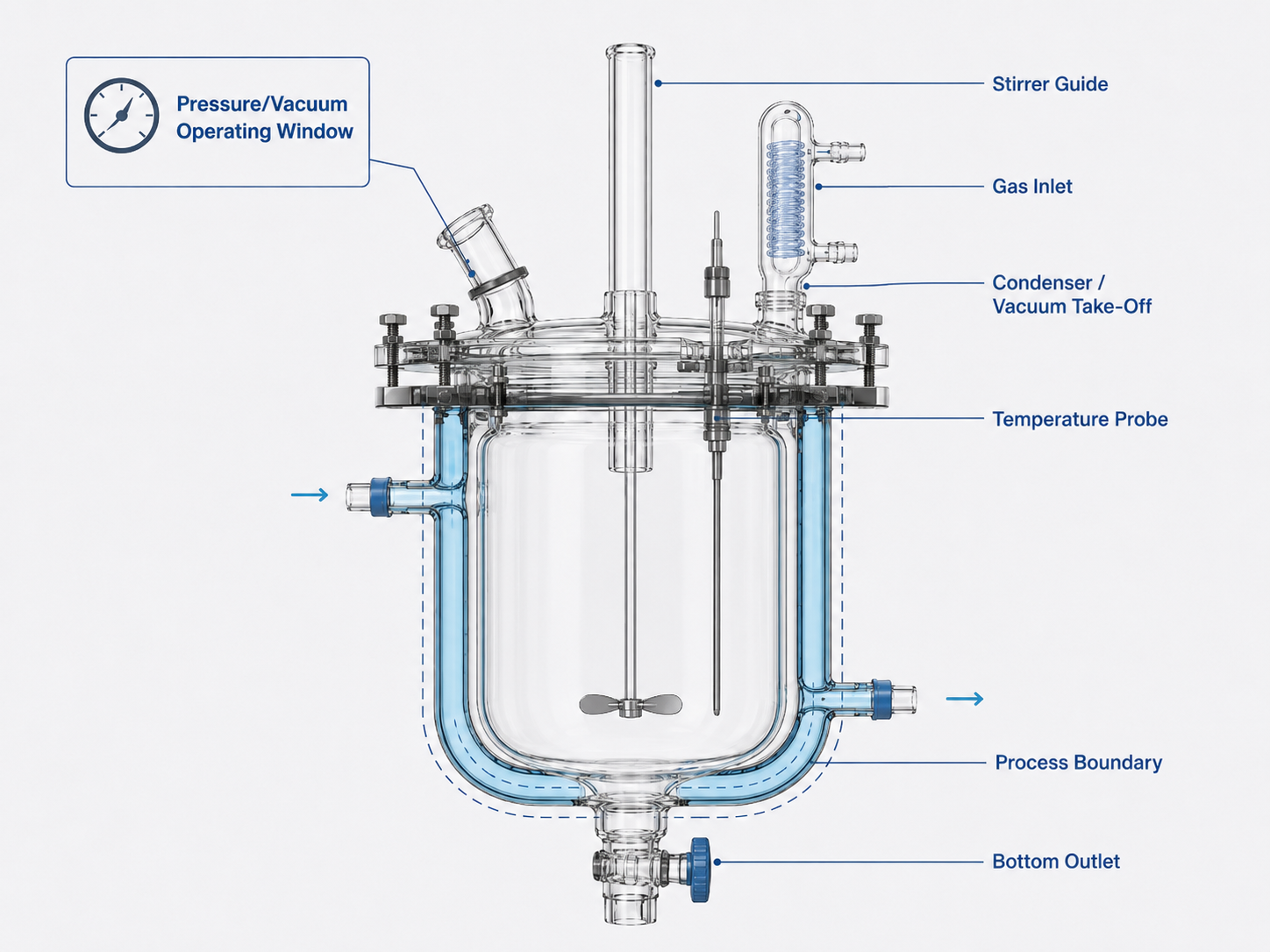
The short answer
Do not specify a laboratory glass reactor by volume and temperature range alone. State the complete operating window first: normal and maximum pressure, full-vacuum requirement, temperature limits, process medium, agitation, connected equipment and abnormal operating scenarios. This allows the reactor vessel, lid, flanges, seals and accessories to be assessed as one system rather than as a collection of catalogue parts.
That distinction matters. A reactor intended for vacuum operation is not automatically suitable for overpressure, and a vessel that is mechanically acceptable at room temperature may need a different assessment at elevated temperature, with volatile media, or when connected to a condenser, pump or gas line.
Why “under vacuum” is not enough
“The process runs under vacuum” leaves too much unanswered for a technically useful quotation. Vacuum can mean a gentle pressure reduction for solvent handling, sustained operation near full vacuum, or repeated evacuation and venting throughout a batch. Each puts different demands on the vessel geometry, flange system, seals, bottom outlet, stirrer guide and attached equipment.
The same problem appears with pressure. A request such as “slight nitrogen pressure” should be translated into a defined maximum operating pressure, not left as a verbal assumption. The relevant value is the pressure at the reactor, including credible upset conditions, not merely the nominal set point on a gas regulator.
For HWS flat-flange reactors, the general catalogue position is explicit: unless otherwise specified, they are intended without pressure or only up to 0.1 bar overpressure. Where a process requires pressure operation, the maximum pressure and temperature must be part of the enquiry so that the execution can be engineered, tested and documented for the application. Read the HWS glass-reactor overview.
Please note: the standard HWS flat-flange reactor is not permitted for use as a pressurised reactor within the meaning of the relevant norms. Where an application genuinely requires pressure, HWS manufactures the execution to the applicable standards as a special order, supplied with a material test certificate. State the maximum pressure and temperature in the enquiry so the correct route can be taken from the outset.
Start with an operating-window statement
Before selecting a vessel, write a one-page operating-window statement. It should answer the questions below.
| Parameter | What to state | Why it changes the specification |
|---|---|---|
| Normal operating pressure | The expected pressure during the main process step | Helps define the routine duty, not just the edge case |
| Maximum allowable process pressure | The highest credible pressure at the vessel | Determines whether a standard configuration is appropriate at all |
| Vacuum requirement | Partial vacuum, deep vacuum or full vacuum; continuous or intermittent | Affects vessel shape, lid, seals, outlet valve and vacuum connection |
| Temperature range | Minimum, normal and maximum process temperature | Pressure and temperature must always be assessed together |
| Medium and vapours | Solvents, gases, corrosives, solids and expected condensate | Drives materials, sealing and condenser selection |
| Agitation | Speed range, viscosity, solids content and shaft type | Affects stirrer guide, seal choice and mechanical loading |
| Connected equipment | Condenser, receiver, vacuum pump, gas supply, dosing system and sensors | The weakest connection can define system integrity |
| Upset cases | Blocked vent, loss of cooling, gas-regulator fault, pump isolation, rapid venting | Avoids designing only for the happy path |
This is not bureaucracy. It is the shortest route to a reactor that can be quoted correctly and operated predictably.
Vacuum duty: specify more than the end pressure
For vacuum applications, include the target pressure, but also state how the vacuum is used.
Continuous vacuum or occasional evacuation?
A solvent-removal step held under vacuum for several hours is different from an inerting sequence that evacuates and backfills a vessel several times. Repeated pressure cycling can make the arrangement of flanges, sealing surfaces and attached components more important than the lowest pressure value alone.
What is attached to the reactor?
The vessel is only part of the vacuum boundary. A practical specification should identify the vacuum take-off, condenser, receiver, cold trap, hoses, valves and the pump. It should also state whether the vessel is stirred during vacuum operation. A rotating shaft is a dynamic seal, so it deserves separate attention. HWS offers stirrer guides and ceramic mechanical seals for applications requiring reliable guided agitation and sealing.
Geometry matters
Vacuum loads act from outside the vessel inward. Geometry, wall profile, bottom design and the reactor head all matter. HWS notes that its torispherical vessel shape and flat-flange lid design support vacuum use, while flat-bottom vessels or vessels with smaller-radius fused discs can have more limited vacuum or slight-overpressure suitability. That is precisely why a supplier needs the duty stated before production, not after delivery.
Pressure duty: do not treat inert-gas blanketing as a footnote
An inert gas blanket is often described as a low-risk detail. It is only low-risk when its pressure limit, venting arrangement and failure modes are defined.
For any request involving nitrogen, argon or another process gas, specify:
- the regulated pressure at the reactor;
- the maximum credible pressure if a regulator, valve or vent does not behave as intended;
- whether gas is used only for blanketing or also for transfer, sparging or pressure filtration;
- the vent path and any downstream condenser, scrubber or receiver;
- whether a reactor may be isolated while heat is still being applied.
Do not assume that a reactor rated for vacuum is also rated for positive pressure. Nor should a pressure request be separated from temperature. A solvent vapour system at elevated temperature, for example, is not adequately described by “slight pressure” and a vessel volume.
The reactor head is a system, not a lid with holes
Pressure and vacuum performance are often lost at the interfaces around the vessel rather than in the main vessel body. A credible enquiry should list every head connection:
- agitator and stirrer guide;
- addition funnel or solid doser;
- temperature probe and sampling port;
- condenser or distillation take-off;
- gas inlet and vent;
- vacuum connection;
- pressure indication or relief arrangement, where required by the process design.
Port spacing and orientation affect whether the system can be assembled, supported and serviced without forcing glassware, hoses or drives out of alignment. If a standard lid does not provide the necessary layout, a custom glass reactor system can be designed around the process interfaces instead of accumulating adapters and compromises.
A practical enquiry checklist
Use this checklist before requesting a quotation for a pressure or vacuum glass reactor:
- Working volume and vessel geometry: nominal volume, typical fill level and whether a flat or rounded bottom is required.
- Pressure window: normal operating pressure and maximum credible pressure at the reactor.
- Vacuum window: target pressure, duration, cycling frequency and whether agitation continues under vacuum.
- Temperature window: minimum and maximum product temperature, plus heating and cooling medium.
- Process medium: solvents, gases, corrosives, solids and expected vapour load.
- Mixing duty: stirrer type, speed, viscosity range and solids content.
- Head layout: all required ports, instruments, addition points, condenser and vacuum connections.
- Discharge and containment: bottom outlet type, receiver arrangement and requirements for low hold-up or residue-free drainage.
- Safety and documentation: site requirements, applicable standards and the documentation needed for the intended duty.
The objective is not to make a simple process look complicated. It is to distinguish a standard laboratory configuration from an application that needs a purpose-engineered execution.
When a custom specification is the sensible choice
Customisation is justified when the operating window cannot be described as ordinary atmospheric laboratory work. Typical triggers include a defined positive-pressure requirement, combined heating and vacuum duty, unusual flange interfaces, non-standard instrumentation, demanding vapour handling or a process where repeated runs must be reproducible without rebuilding the head assembly each time.
HWS develops glass reactor systems around vessel geometry, thermal control, mixing and interfaces. The useful starting point is a clear operating-window statement. From there, the reactor, lid, accessories and documentation can be matched to the process rather than guessed from a catalogue photograph.
Conclusion
The correct pressure and vacuum specification is not a single number. It is a description of how the reactor will actually operate, including temperature, media, agitation, connections and credible upset conditions.
Give the supplier that information before ordering. It prevents unsuitable standard configurations, reduces late design changes and makes the resulting laboratory reactor safer and more useful from its first batch.
Discuss a custom glass-reactor requirement with HWS Labortechnik
FAQ
Is a glass reactor suitable for pressure operation?
Only when its execution is explicitly designed and documented for the specified pressure and temperature duty. HWS states that its standard flat-flange reactor execution is normally without pressure or limited to 0.1 bar overpressure unless a special pressure requirement is specified.
Does a vacuum-capable glass reactor automatically handle overpressure?
No. Vacuum and positive pressure load the vessel and its interfaces differently. State both requirements separately in the enquiry.
What should I send with a reactor enquiry?
At minimum: process volume, pressure and vacuum range, temperature range, media, agitation duty, desired head connections and the equipment connected to the reactor. A P&ID or simple process sketch is useful where available.
Why does the stirrer guide matter for vacuum operation?
The stirrer shaft passes through a moving interface in the reactor head. Its guide and sealing arrangement influence leakage risk, mechanical alignment and operating reliability during stirred vacuum duty.