
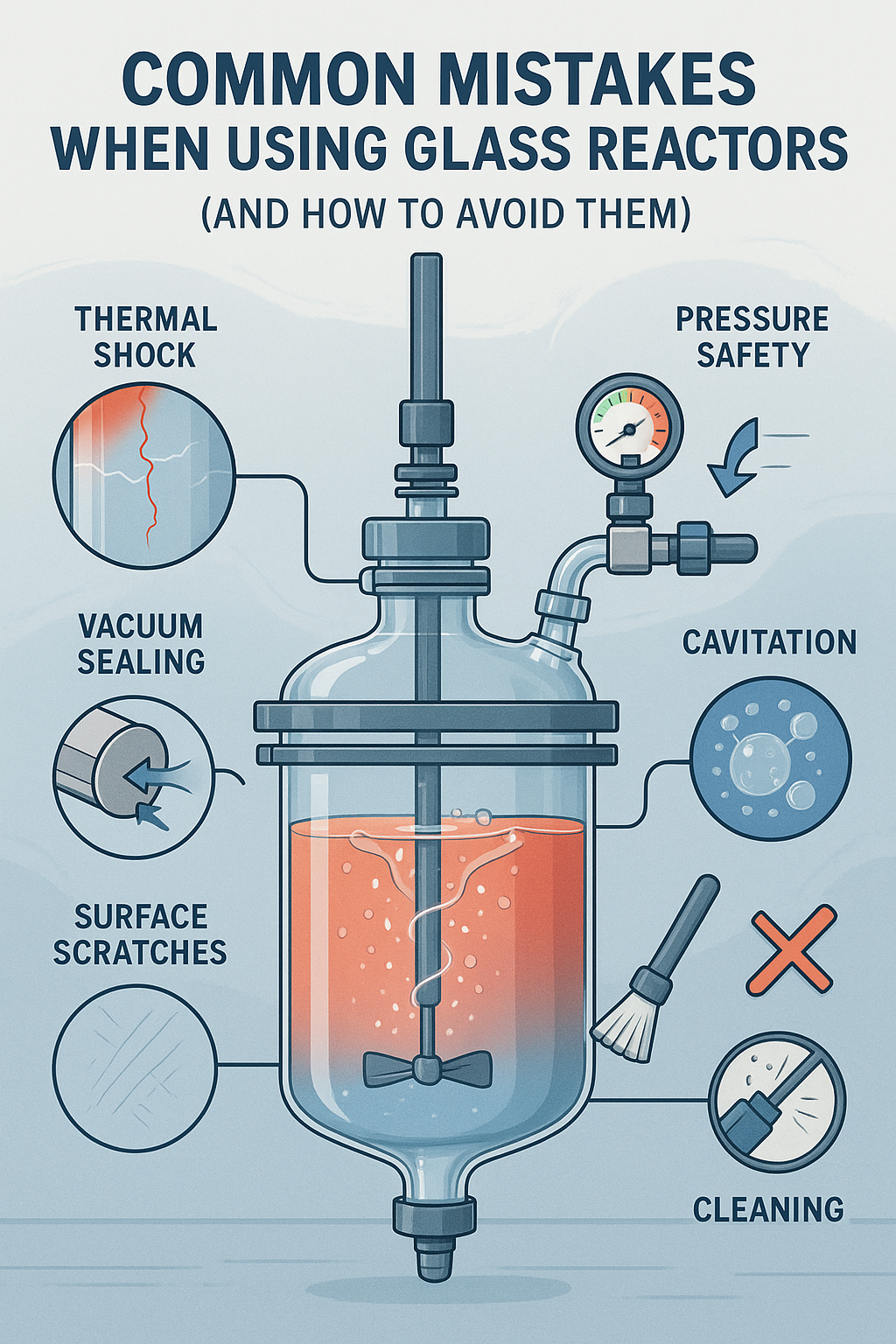
Borosilicate glass reactors are the default vessel for chemical synthesis, pharmaceutical R&D and pilot-scale development, because they combine visibility with chemical resistance that exceeds most metals. They are also more forgiving than their reputation suggests — borosilicate 3.3 is a genuinely robust material, not delicate laboratory ornament.
Most failures in service are not material failures. They are specification and handling errors: a duty the vessel was never built for, a geometry mismatched to the process, or a seal chosen for the wrong medium. Here are the mistakes that actually cause damage, and how to avoid them.
Treating a glass reactor as a pressure vessel
This is the most consequential misunderstanding, and it usually comes from experience with glass-lined steel — a different product entirely, where several bar of working pressure is routine.
Unless a specific execution has been engineered and documented for it, an HWS flat-flange reactor is intended for operation without pressure, or with a slight overpressure of up to 0.1 bar. Using the standard execution as a pressurised reactor within the meaning of the relevant norms is not permissible.
That is not a reason to avoid pressure work. It is a reason to declare it up front. Where a process genuinely requires pressure, state the maximum pressure and temperature in the enquiry: the reactor is then manufactured to the applicable standards as a special order and supplied with a material test certificate. HWS also supplies overpressure valves in defined ratings from 0.1 bar upward, so the protection can be matched to the declared duty rather than improvised.
The failure mode to avoid is silent pressure — a blocked vent, an isolated reactor still under heat, or a gas regulator faulting open. None of these appear in a process description, and all of them can put a vessel well past 0.1 bar.
Assuming any glass vessel handles vacuum equally
Vacuum loads act inward, so geometry decides the outcome more than wall thickness does.
The HWS flat-flange reactor is well suited to vacuum because of its torispherical vessel shape and the profile of the flat-flange lid. But that suitability is not universal across the catalogue: vessels with a flat bottom, or with a fused disc of smaller radius, are only suitable for vacuum or slight overpressure in limited circumstances.
If a vessel was specified for atmospheric work and is later pressed into a solvent-stripping role under deep vacuum, the geometry may simply not be right for the new duty. Check the execution before changing the process, not after.
Believing borosilicate is inert to everything
Borosilicate 3.3 is rated hydrolytic class 1 and acid class 1 — it is highly resistant to water, neutral and acidic solutions, concentrated acids and their mixtures, chlorine, bromine and organic media, and holds that resistance through extended reactions above 100 °C.
Its alkali rating is different: alkaline solution class 2. Three media attack the glass surface progressively:
- Hydrofluoric acid — attacks borosilicate directly. Never in a glass vessel.
- Very hot phosphoric acid — attack increases sharply with temperature.
- Alkaline solutions — the slow one, and the one that catches people out. Hot caustic cleaning cycles etch the surface over time.
Surface attack rarely announces itself as breakage. It shows up as a gradual loss of optical clarity and a roughened inner wall — which then becomes the seed for the mechanical problems below.
Confusing thermal shock with thermal gradient
Borosilicate 3.3 has a linear expansion coefficient of just 3.3 × 10⁻⁶/K between 20 and 300 °C, which is precisely why it tolerates temperature change so well. Its maximum allowable service temperature is 500 °C on a temporary basis, far above any normal process.
The practical risk is therefore not absolute temperature. It is a steep gradient across a short distance — typically between jacket and contents, or across a thick fused section such as a flange root or a bottom outlet where the wall changes thickness. Uneven expansion in those transitions produces tensile stress, and glass fails in tension.
What actually helps:
- Ramp the thermostat rather than stepping it, especially when crossing a solvent boiling point.
- Precondition the vessel before charging hot or cold material — a large ΔT between charge and vessel is the classic avoidable case.
- Keep the jacket clean. Deposits create local hot and cold spots that turn a uniform jacket temperature into a gradient.
- Watch the thick sections, not the thin ones. Flange roots and outlets equilibrate slowest.
Letting glass meet metal, and dismissing scratches
A scratch on a borosilicate surface is a stress concentrator. It reduces the load the wall can carry under vacuum and under thermal cycling, and the failure it eventually causes will look sudden and unexplained.
The usual sources are mundane: a metal spatula used to dislodge residue, a clamp tightened directly onto glass without a compliant interface, glassware set down on a bare bench, or a vessel supported on its outlet rather than on its proper supporting construction.
Use non-metallic tools inside the vessel. Support the reactor as designed. Treat any new scratch on a pressure- or vacuum-duty vessel as a reason to inspect rather than a cosmetic issue.
Choosing a seal for the reactor instead of for the medium
The glass is usually the most chemically resistant part of the assembly. The seals are not.
HWS stirrer guides are built around a PEEK body with ceramic and graphite sliding rings, a borosilicate adapter and a PEEK guide sleeve, sealed with Viton or Kalrez depending on the application. That choice is made per order, and it is made from the process medium and temperature — not from the vessel size.
A rotating stirrer shaft is a dynamic seal, so it deserves separate attention from every static joint on the lid. If a vessel is stirred under vacuum, say so in the enquiry: it changes the sealing arrangement.
Losing the serial number
Every HWS reactor has its manufacturing date and a unique consecutive serial number permanently burned into the glass, with the full production record held in an internal database. Spares and re-orders are placed by quoting that number alone.
Labs that record it in the equipment file get exact replacement parts. Labs that do not end up measuring flanges and guessing. It costs nothing to write down on commissioning day.
A short pre-run check
- Is the declared pressure duty within the vessel’s execution, or does it need an engineered version?
- Does the vessel geometry suit the vacuum you actually intend to pull?
- Does anything in the process — or in the cleaning cycle — involve HF, hot phosphoric acid or hot alkali?
- Are the temperature ramps controlled, and is the jacket clean?
- Any new scratches, chips or clouding since the last run?
- Are the seal materials right for this medium, not just for this vessel?
- Is the serial number on file?
Specify the duty, and the vessel follows
Nearly every entry above traces back to the same root cause: the vessel was asked to do something it was never specified for. Borosilicate 3.3 will handle aggressive chemistry, deep vacuum and long thermal cycling for years — provided the execution was matched to that duty before it was built.
If your operating window has changed since the reactor was ordered, that is the moment to check the execution rather than the moment to find out.