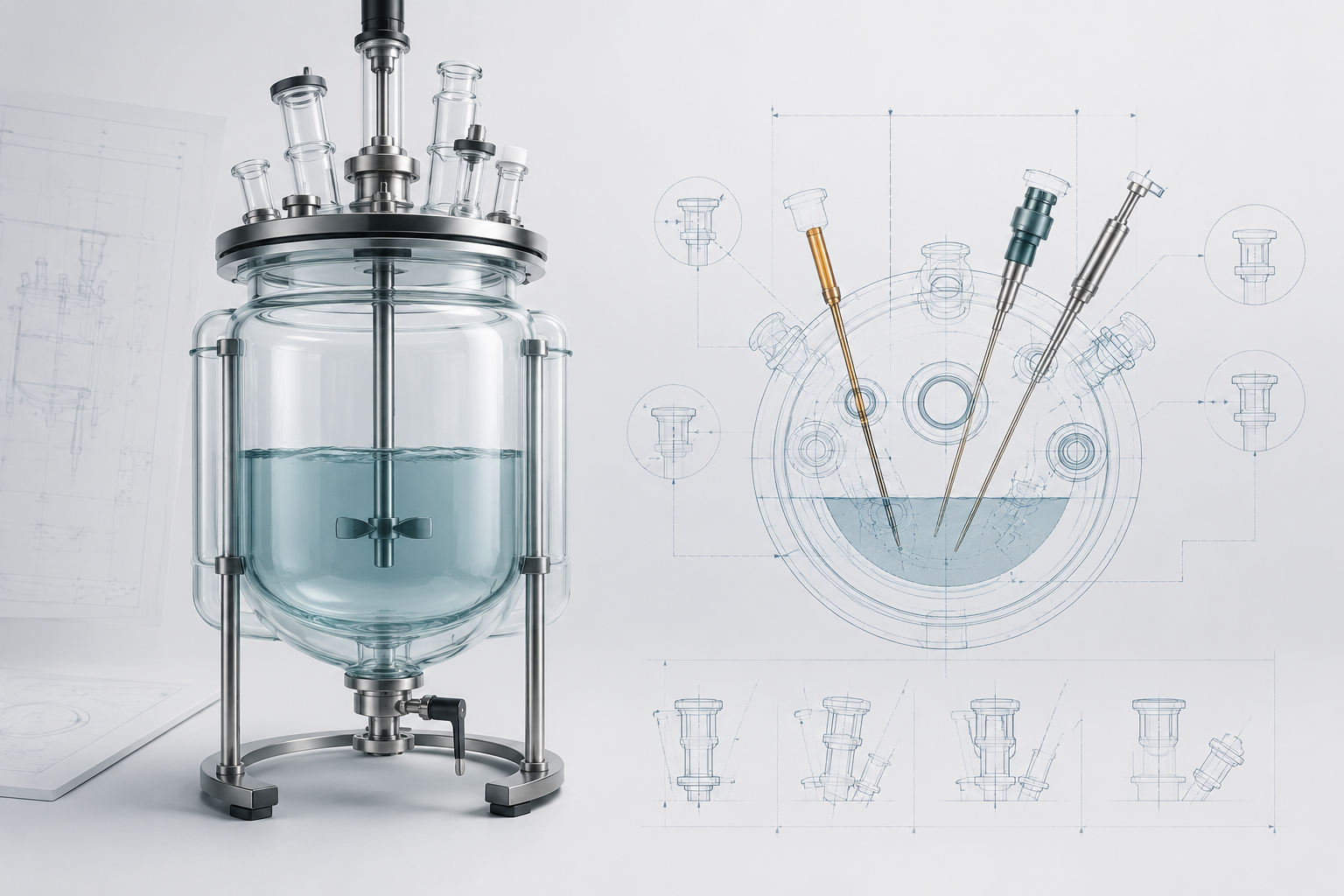
PAT-readiness must be designed before a glass vessel is built, because probe ports and their geometry cannot simply be relocated after the vessel is fused. The port map needs to account for probe position, immersion depth, stirring, baffles, condensers, dosing lines, and cleanability so analytical probes can produce representative readings.
What “PAT-ready” actually means
A PAT-ready glass reactor is a vessel whose ports, internal geometry, temperature measurement, sampling provisions, and cleanability are designed so that analytical probes can be installed in representative positions, read reliably, and be qualified and cleaned — without modifying the vessel after the fact.
Note what this definition does not say. It does not say the reactor ships with sensors installed, and it does not commit you to one analytical technique. PAT-readiness is about optionality built into the glass: the right number and geometry of access points, positioned against the mixing and heat-transfer reality of your chemistry, so that today’s pH and temperature probes and tomorrow’s spectroscopic probe both have a proper home. The move from offline sampling to genuine in-line measurement is exactly the transition covered in our discussion of integrated sensors in glass reactor systems; this article is about the vessel design that has to precede it.
Why the specification cannot wait until after the build
The engineering reason is simple and unforgiving. A Borosilicate Glass 3.3 reactor lid or vessel wall carries a fixed set of ground-glass or flanged nozzles, each with a defined bore (specified as a DN nominal diameter), angle, and length. These are formed during manufacture. Adding a port afterwards means annealing new glasswork into a finished component — in practice, a new lid. So every port you might want in the reactor’s working life has to be anticipated now.
This is where a purely catalog-based approach can quietly constrain a project. A standard lid offers a fixed nozzle count and layout chosen for general use. That is perfectly adequate for many reactions — but PAT frequently needs more, and more specific, access than the default provides: an angled port to reach the well-mixed zone, an extra nozzle for an optical probe alongside the stirrer, dosing line, and condenser that are already there. When a standard configuration is not enough, the port map itself becomes part of the reactor design.
The specification checklist
Port count, bore, and the fight for the lid
Begin by listing every penetration the reactor must carry at once: overhead stirrer, reflux or condenser, thermowell, charging and dosing lines, inert-gas inlet, pressure or vacuum connection — and then the analytical probes. Only now is the true port demand visible, and it is almost always higher than a default lid assumes. Each probe also dictates a bore: a pH electrode, an ATR-FTIR or Raman immersion probe, and a focused-beam particle probe are different diameters and cannot share a socket. Specify one DN bore per intended probe, and specify at least one spare port — the cheapest insurance in the whole build.
Placement: representative, not merely available
A reading is only as good as the location it is taken from. Double the linear scale of a vessel and its volume rises with the cube while wall surface rises only with the square, so mixing and heat transfer do not keep pace — quiet zones and gradients appear that a small flask never showed. A probe dropped into such a zone gives a stable, confident, unrepresentative number. Ports intended for analytics should therefore be positioned and angled to reach the actively mixed region, clear of the vessel wall and the stirrer’s immediate shadow. This is a geometry problem best solved together with the stirrer and mechanical-seal arrangement, because the impeller position defines where “representative” actually is.
Immersion depth and the working volume
Immersion depth follows from the fill volumes the chemistry will really use — not the nominal reactor size. A probe specified for a full vessel can sit in the headspace at a 40 percent fill, reading vapour instead of liquid. Give your supplier the range of working volumes, and the port length and probe insertion can be matched to keep the sensing tip submerged across the whole campaign.
Temperature measurement done properly
Temperature is the most-used PAT signal and the easiest to get subtly wrong. A thermowell decouples the PT100/RTD sensor from the process for easy replacement but adds thermal lag; a directly wetted probe responds faster but complicates cleaning and change-out. Either way, the measurement point should sit in the bulk liquid, not against the jacket wall, so it reflects the reaction rather than the heat-transfer fluid. The trade-offs here connect directly to how the whole system holds a setpoint, which we cover in achieving precise temperature control in glass reactors.
Optical access for spectroscopy
Spectroscopic techniques add their own constraints. Immersion probes need a clear, bubble-free, non-fouling path at the probe window; the port angle should discourage gas hold-up and solids build-up on the optics. Where a probe cannot be immersed, a flush-mounted window or a recirculation loop may be the better route. These decisions change the nozzle geometry, so they belong in the specification, not in a later workaround.
Sampling for at-line and reference methods
Even a well-instrumented reactor needs clean withdrawal for at-line analysis and for the reference data that validates an in-line model. A representative sample should come from the mixed bulk, not a stagnant leg. A well-designed bottom outlet valve with minimal dead volume is often the most reliable sampling point, and specifying it now avoids a compromised sample route later.
Cleanability and qualification
Every port, pocket, and probe recess is a surface that must be cleaned and, in GMP work, qualified. A blind pocket or an over-tight probe fit can trap residue and defeat cleaning validation. Design ports so probes can be removed and the recess reached or flushed, and keep internal transitions smooth. In regulated environments this is not optional housekeeping — it feeds directly into equipment qualification and the cleaning evidence discussed in our guide to cleaning validation for glass reactors.
Common mistakes to design out
- Too few ports. The single most frequent regret. Analytics loses to the stirrer, condenser, and dosing lines because no one counted them together at the start.
- A probe in a dead zone. A perfectly calibrated sensor reporting an unrepresentative region — the most dangerous failure because the data still looks trustworthy.
- Wrong immersion for the real fill. Specifying to nominal volume instead of the actual working range.
- Ignoring cleanability. Probe pockets that pass a pressure test but fail a swab test.
- No spare capacity. The method that works in development often calls for one more probe in the tech-transfer vessel; a blanked spare port makes that a five-minute change instead of a re-order.
From representative signal to real-time control
Specifying the vessel well is what makes everything downstream possible. Once probes sit in representative positions and return trustworthy data, that data can drive feedback control, endpoint detection, and the model-based approaches described in our overview of AI-assisted reaction monitoring. None of it works if the underlying signal is compromised by geometry — which is precisely why the port map is the foundation of the control strategy, not an accessory to it.
For teams in regulated pharmaceutical development, this design-first logic is also the regulators’ logic. The FDA’s Process Analytical Technology framework treats measurement and control as built into process design, and the ICH Q8/Q9/Q10 quality guidelines frame quality as designed in, not tested in. The cleanability and equipment provisions above map onto the qualification expectations set out in EU GMP Annex 15 on qualification and validation. A vessel specified with these in mind is far cheaper to qualify than one retrofitted after the fact.
Conclusion
PAT-readiness is decided in the geometry of the glass, and the glass is decided before it is built. The chemist who arrives at the design conversation with a full port census, a mixing-aware placement plan, the real range of working volumes, a temperature-measurement strategy, sampling provisions, and cleanability in mind will get a reactor that yields representative, qualifiable data for years. The chemist who defers those decisions inherits a vessel that fights every analytical ambition.
This is exactly the kind of problem a custom approach is built for. A standard vessel serves many reactions well, but a genuinely PAT-ready reactor usually needs its port map, geometry, and access designed around a specific process and its analytical roadmap. When a standard configuration is not enough, the difference is decided at the drawing stage — which is the right time to involve people who both blow the glass and understand the process.
Discuss a Custom Glass Reactor Solution
Planning in-line analytics for a new or existing process? Request a consultation to design a custom glass reactor system, and work with HWS engineers to specify a custom, PAT-ready benchtop flange glass reactor — port map, probe geometry, and cleanability tailored to your chemistry before a single nozzle is fused.