
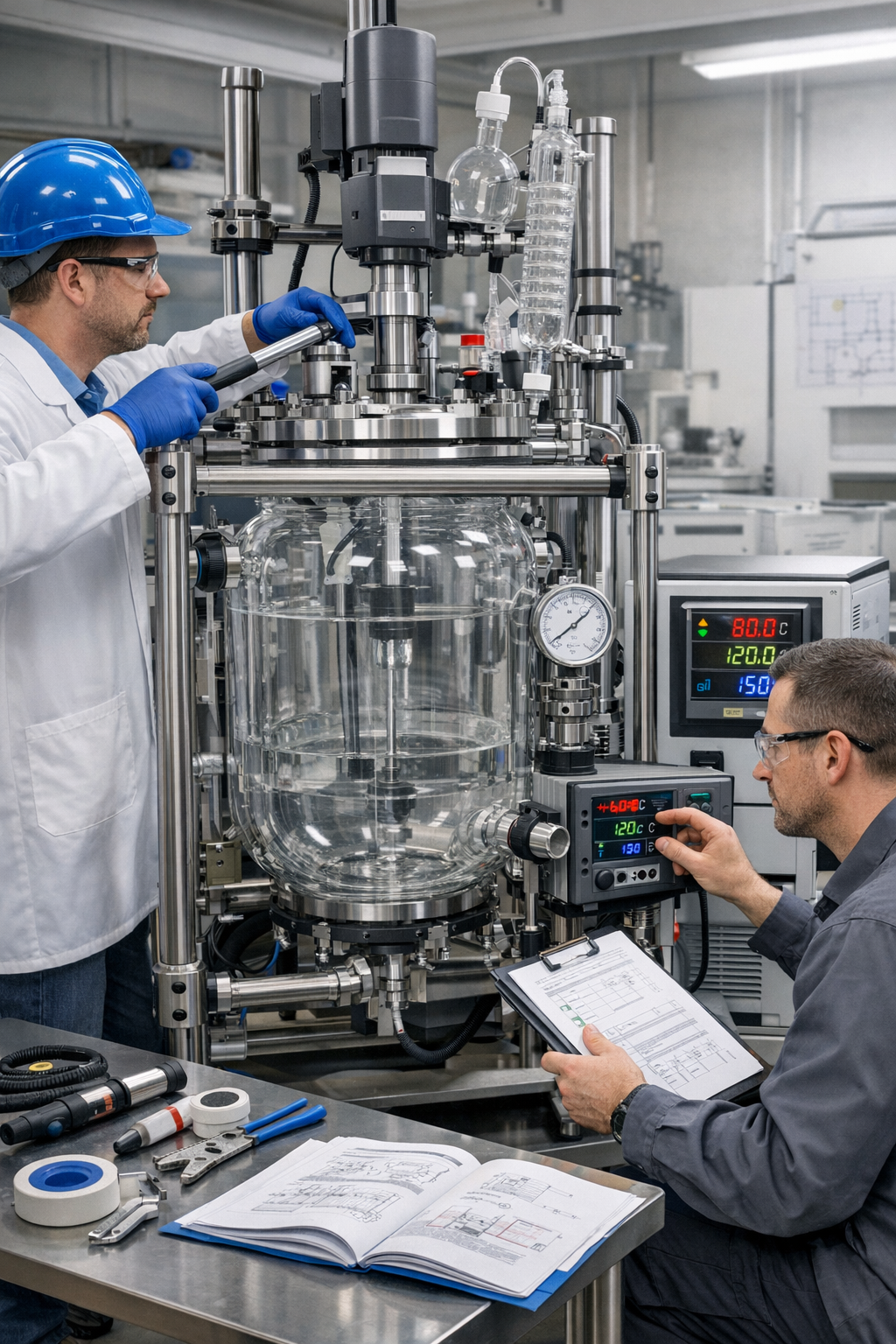
Proper installation and configuration of a glass reactor system determines heat transfer efficiency, mechanical safety, and batch reproducibility from day one.
TL;DR – Top 4 Technical Takeaways
-
Improper torque on ground glass joints causes stress fractures and vacuum leaks.
-
Controlled thermal ramp rates prevent jacket cracking and seal failure.
-
Leak testing under vacuum is mandatory before first process use.
-
Correct PID tuning and sensor calibration determine temperature accuracy and reproducibility.
Introduction: The First Heat-Up Failure
A new 50-liter jacketed glass reactor is assembled. The chiller is connected. The stirrer runs smoothly. Everything appears ready.
However, the temperature ramps from 25 °C to 120 °C too quickly. A sharp sound follows. Fine cracks appear near the jacket inlet. The reactor is compromised before its first batch.
In my experience at the bench, this scenario is not rare. It typically occurs when installation and configuration are treated as simple assembly rather than controlled commissioning.
A glass reactor is not merely a vessel. Instead, it is a thermodynamic system operating under mechanical and thermal stress. Therefore, the difference between a smooth startup and costly downtime lies in how the system is installed, calibrated, and validated.
How to Install and Configure Glass Reactor Systems
Glass reactor installation and configuration refers to the structured mechanical assembly, thermal setup, fluid connection, instrumentation calibration, and operational validation of a jacketed borosilicate vessel system to ensure safe, leak-free, and thermally stable chemical processing under defined laboratory or pilot-scale conditions.
In other words, installation is the foundation of reliable process performance.
Knowledge Card: Key Engineering Metrics
Heat Transfer Equation:
Q = U × A × ΔT
Where:
-
Q = heat transfer rate (W)
-
U = overall heat transfer coefficient (W/m²K)
-
A = heat exchange surface area (m²)
-
ΔT = temperature difference between jacket fluid and process mass
Vacuum Integrity Target:
Typically, an acceptable leak rate is less than 1 mbar pressure rise over 10 minutes in a closed system.
Thermal Ramp Rate:
Generally recommended: 1–3 °C per minute depending on vessel size and jacket geometry.
The Process: Step-by-Step Installation and Configuration
To ensure reliability, follow a structured and documented approach.
-
Inspect all glass components.
First, examine borosilicate 3.3 glass for scratches, inclusions, or microcracks. Even minor defects can propagate under thermal stress. -
Level the support frame.
Next, use a precision spirit level. Uneven load distribution increases stress on the vessel flange and bottom discharge valve. -
Mount the reactor vessel carefully.
Then align the vessel centrally. Avoid lateral force. Tighten clamps evenly according to manufacturer torque specifications. -
Install PTFE gaskets and ground glass joints.
Ensure uniform compression. Over-tightening creates stress concentration and can damage sealing surfaces. -
Align the overhead stirrer and mechanical seal.
Verify shaft centricity and minimal runout. Otherwise, vibration and premature seal wear may occur. -
Position the impeller correctly.
Adjust according to design clearance from the vessel bottom. Impeller height directly affects mixing regime and shear profile. -
Connect the jacket inlet and outlet lines.
Use chemically compatible hoses. At the same time, avoid restrictions that reduce flow rate and heat transfer efficiency. -
Integrate the temperature control unit.
Connect the circulating thermostat or chiller. Confirm flow capacity and pressure compatibility before startup. -
Calibrate temperature sensors.
Validate PT100 or RTD probes against a certified reference thermometer. Subsequently, document deviations. -
Tune the PID controller.
Adjust proportional, integral, and derivative settings to prevent overshoot and oscillation. During pilot phase, we often observe instability due to aggressive factory defaults. -
Conduct a vacuum hold test.
Seal the system and apply vacuum. Then monitor pressure stability over time. Identify leaks at joints, valves, or mechanical seals. -
Perform a controlled thermal ramp test.
Gradually increase temperature. Meanwhile, observe expansion behavior and monitor gasket compression. -
Document Installation Qualification (IQ).
Record serial numbers, torque values, calibration data, and leak test results. -
Execute Operational Qualification (OQ).
Finally, run water-based validation batches to verify thermal control and agitation performance before introducing reactive chemicals.
Critical Analysis: Why Installation Discipline Matters
Installation directly impacts:
-
Heat transfer efficiency
-
Vacuum performance
-
Agitation uniformity
-
Safety during operation
-
Long-term mechanical stability
Therefore, the commissioning phase should never be rushed.
Below is a structured comparison that many lab managers consider.
| Criteria | In-House Installation | Professional Installation |
|---|---|---|
| Efficiency | Dependent on internal expertise | Optimized through calibrated setup |
| Cost | Lower upfront | Higher initial cost |
| Safety Profile | Risk of improper sealing or stress | Structured validation and documentation |
| Scalability | May lack formal qualification | Prepared for GMP documentation |
While both approaches can succeed, error probability decreases significantly when experienced technicians perform the commissioning.
Where This Goes Wrong
Most failures are subtle. Nevertheless, their consequences can be significant.
Thermal Shock
Rapid heating creates differential expansion between jacket and vessel wall. As a result, stress concentrates near inlets and flanges.
Excessive Clamp Torque
Over-tightening introduces point loads. Consequently, cracks often form near transitions or flange edges.
Improper Mechanical Seal Alignment
Misalignment leads to leakage under vacuum and solvent loss during reflux.
Uncalibrated Sensors
Temperature deviation of several degrees affects reaction kinetics and reproducibility. Over time, this undermines process validation.
Incomplete Leak Testing
If vacuum validation is skipped, solvent vapor escape or pressure instability may appear later during operation.
For this reason, methodical installation and documented verification are essential.
Lab Manager Perspective
Lab managers typically worry about:
-
Breaking expensive glass during assembly
-
Delaying pilot or scale-up timelines
-
Failing compliance audits
-
Voiding warranty due to incorrect setup
-
Losing reproducibility in early batches
At the same time, they expect:
-
Clear documentation
-
Predictable startup
-
Minimal downtime
-
Confidence in mechanical integrity
However, many feel less confident with PID tuning, vacuum validation, and mechanical seal configuration. These areas require experience beyond routine laboratory chemistry. Consequently, installation becomes both a technical and operational risk point.
FAQ Section
How long does it take to install a glass reactor system?
Installation usually requires one to two days depending on system size. This includes assembly, leak testing, calibration, and initial validation. Larger pilot systems may require additional commissioning time.
Can I install a glass reactor myself?
Yes, provided you have mechanical and process expertise. However, improper torque or thermal ramping can cause damage. Therefore, professional commissioning significantly reduces risk.
How do you test a glass reactor for leaks?
Use a vacuum hold test. Apply vacuum, isolate the system, and monitor pressure rise over a defined time interval. If the pressure remains stable, sealing integrity is acceptable.
What causes glass reactors to crack during startup?
Rapid temperature changes, uneven clamp torque, and pre-existing microcracks are common causes. Consequently, controlled ramp rates and proper alignment prevent most failures.
Professional Installation and Configuration by HWS
Ultimately, proper installation protects both your investment and your process integrity. For this reason, HWS offers comprehensive installation and configuration services for glass reactor systems.
HWS technical specialists handle:
-
Complete mechanical assembly
-
Precision alignment and torque-controlled sealing
-
Temperature sensor calibration
-
PID parameter optimization
-
Vacuum integrity testing
-
Installation Qualification documentation
-
Operational validation support
As a result, your reactor system is fully configured, documented, and ready for operation. Downtime is minimized. Risk is reduced. Your team can focus on chemistry rather than troubleshooting hardware.
If you are planning to install a new glass reactor system, or if you want to ensure that your existing system is configured correctly, reach out to HWS through the website contact form to discuss your installation requirements with a technical specialist.
Author Bio
Dr. Jürgen Haas, PhD in Chemical Engineering, has over 15 years of experience in laboratory and pilot-scale reactor systems. He has supervised installation, commissioning, and validation of glass reactors across research institutions and pharmaceutical pilot facilities. His expertise includes heat transfer optimization, vacuum system integrity, and process reproducibility validation.