One-Line Deck: A practical engineering guide to selecting and configuring a lab-to-pilot glass distillation setup that returns solvent clean enough to put straight back into the process.
TL;DR / Key Takeaways
- Most labs already intend to recover solvent; the gap is in the setup. A recovery train designed around the solvent and its reuse specification — not around whatever glassware is on the bench — is what separates reusable distillate from a second waste stream.
- The three core decisions are the separation method (simple, fractional, or short-path), the vacuum and heat-transfer strategy, and how you cut and qualify fractions. Each follows from the solvent’s volatility, thermal sensitivity, and target purity.
- Recovery does not scale linearly. Volume rises with the cube of linear dimension while heat-transfer area rises with the square, so a setup that works at 1 L can become condenser- or jacket-limited at 20 L.
- A configuration matched to your boiling points, azeotropes, and footprint usually means a purpose-built glass train rather than a catalogue assembly — which is where a custom approach earns its place.
Introduction
Ask a process chemist whether their lab recovers solvent and the answer is usually yes. Ask whether the recovered solvent goes back into a reaction, and the answer is often more careful. A great deal of “recovered” solvent is distilled once, found to be wet or off-spec, and quietly sent to waste a second time.
The intent is rarely the problem. The setup is. Solvent recovery is a separation, and a separation is only as good as the boundary conditions it is built around: relative volatility, thermal sensitivity, the presence of azeotropes, and the purity the downstream step actually requires. For German process engineers, the useful question is not “can we distil this off?” but “can we repeatably return solvent at a defined quality, batch after batch?” That reframing changes how the equipment is chosen.
This article treats solvent recovery as an engineering design exercise. The case for recovering solvent — waste reduction, cost, sustainability — is well established and covered in our overview of lab-scale distillation for solvent recovery in pharma R&D. Here the focus is narrower and more practical: how to design the recovery train itself.
Start With the Solvent and the Reuse Specification
A recovery setup should be specified backwards, from the quality the solvent must meet to be reused. A solvent destined for a non-critical wash can tolerate trace impurities that would be unacceptable in a final-step recrystallisation. Define that target first; it sets everything downstream.
Two physical properties govern the design. The first is relative volatility — how far apart the components boil. Removing a single low-boiling solvent from a high-boiling residue is an easy separation; pulling apart two solvents with close boiling points is not. Reliable boiling-point and vapour-pressure data, such as the values in the NIST Chemistry WebBook, are the right starting point rather than memory or a supplier sheet.
The second is the presence of azeotropes. Tetrahydrofuran and water, for example, form a low-boiling azeotrope, so simple distillation alone will not return anhydrous THF — the recovered fraction carries water until that azeotrope is broken. Knowing this before you build the train prevents the most common disappointment in solvent recovery: a clean-looking distillate that fails a water-content check.
It also pays to decide, early, whether a given solvent is worth recovering at all. Tools like the ACS GCI Pharmaceutical Roundtable solvent selection guide help rank solvents by safety and environmental profile, which is useful when choosing which streams to prioritise for a recovery loop and which to substitute instead.
Choosing the Separation Method
Three configurations cover the majority of lab and pilot recovery work. The choice follows directly from volatility and thermal sensitivity.
Simple distillation suits clean separations where one volatile solvent must come off a much higher-boiling residue and no fine fractionation is needed. It is the workhorse for first-pass recovery — for example, stripping ethyl acetate (boiling near 77 °C) or acetone from a reaction mixture before work-up.
Fractional distillation is needed when components boil close together and a single theoretical stage will not deliver the required purity. Adding a packed or structured column introduces multiple equilibrium stages, sharpening the separation at the cost of throughput and a longer thermal path. This is where reflux control becomes decisive — a topic we treat in depth in our guide to precision control in distillation processes.
Short-path distillation comes into play for thermally sensitive or higher-boiling materials, where minimising residence time and temperature matters more than stage count. By shortening the vapour path and operating under stronger vacuum, it lowers the effective boiling temperature and reduces the risk of degradation.
A useful selection heuristic: start with the simplest method that can meet the reuse spec, and add complexity (a column, deeper vacuum) only when a real purity gap forces it. Over-engineering a recovery train wastes energy and bench space without improving the result.
Vacuum Strategy and Heat Transfer
Distillation temperature is not a fixed property of the solvent — it is a property of the solvent and the pressure. Reducing pressure lowers the boiling point, which protects heat-sensitive compounds and, for high-boiling solvents, brings the separation into a temperature range a standard heating bath can reach. A controlled vacuum is therefore one of the most powerful levers in a recovery setup, not merely an accessory.
The trade-off is on the condensation side. Lowering the boiling point widens the gap between vapour temperature and coolant temperature you need to actually condense the vapour. Pull too hard on the vacuum without adequate condenser duty and coolant capacity, and solvent vapour is lost to the pump instead of collected — recovery yield falls precisely because the setup looks more aggressive. Condenser surface area and coolant temperature must be matched to the vapour load; our note on specifying reflux and condenser setups covers how to size that duty.
Stable heat input matters just as much. A jacketed vessel with a circulating thermostat gives the controlled, even heating that a heating mantle cannot, which keeps the boil-up rate steady and the separation reproducible. Even, well-controlled heat transfer is the difference between a distillation curve you can repeat and one that drifts with every run.
Configuring the Glass Recovery Train
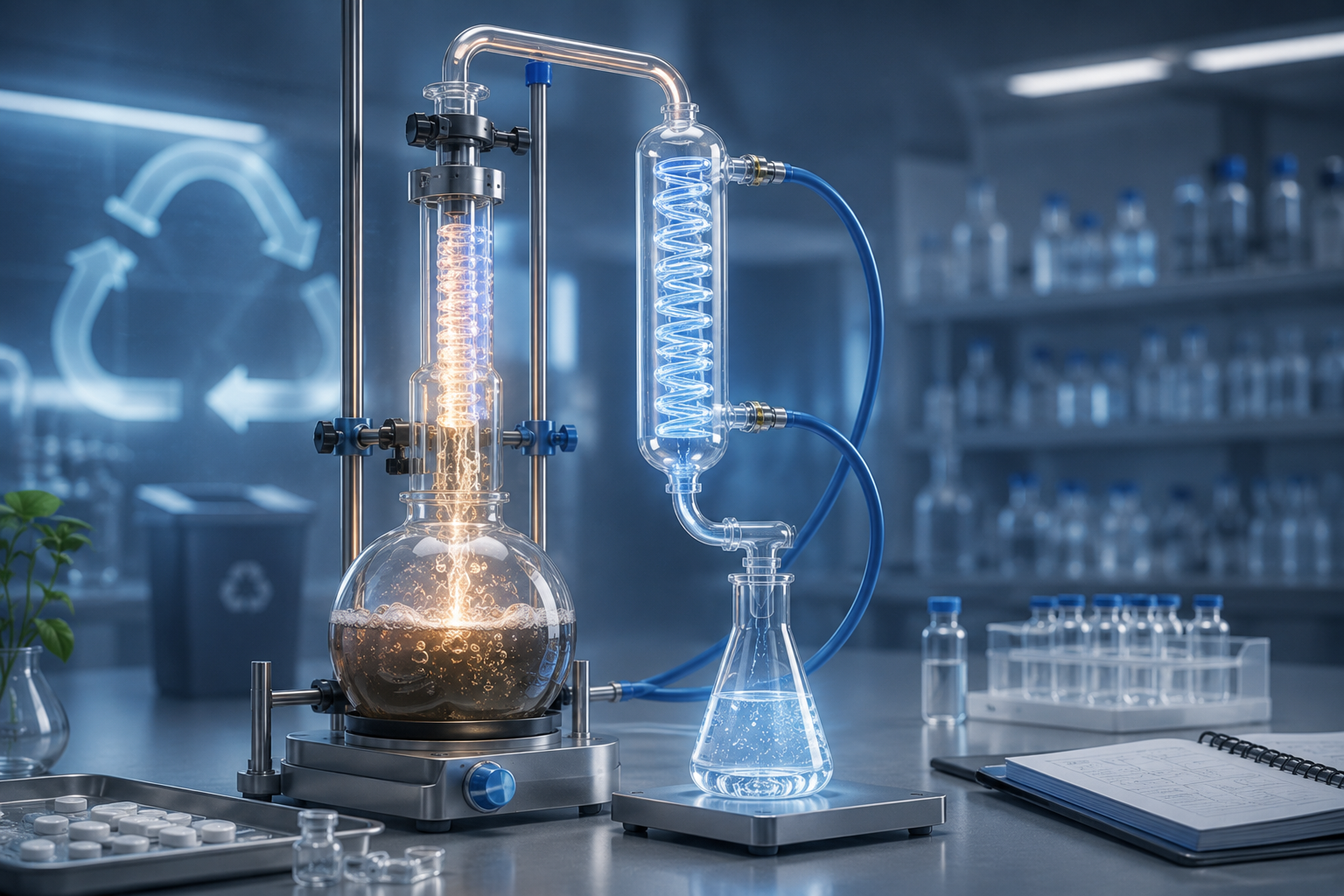
A complete lab recovery train is a small system: a heated vessel, a column where fractionation is required, a condenser, a receiver — ideally with a means to switch receivers so fractions can be separated — and the vacuum and temperature control around them. The art is in matching those parts to each other and to the specific separation.
This is where a custom benchtop glass reactor configured for distillation tends to outperform a loose assembly of catalogue parts. At HWS, we usually start with the process before we talk about the glassware: which solvents, what boiling points and azeotropes, what reuse spec, what footprint, and whether the same vessel must also serve as a reaction or work-up vessel. From those boundary conditions the geometry follows — jacket sizing for the required boil-up rate, column dimensions for the needed stages, condenser area for the vapour load, and a clean path to the receiver.
Practical details decide whether a train is usable day to day. A bottom outlet lets the high-boiling residue be drained without breaking down the assembly. Joint and seal choices determine whether the system holds vacuum reliably. Clear sightlines let an operator watch the distillation front and the receiver fill. Unlike a purely catalogue-based approach, a configuration built around your actual solvents and bench constraints removes the compromises that quietly cap recovery quality — without claiming any single standard component is inadequate on its own.
Scaling the Recovery Loop From Bench to Pilot
A recovery train proven at 1 L does not simply enlarge to 20 L. The reason is geometric: volume grows with the cube of the linear dimension while heat-transfer surface grows only with the square. Double the linear size and volume rises roughly eightfold, but jacket and condenser area only about fourfold. Heating and, critically, condensing therefore become the limiting steps as scale increases.
The practical consequences are concrete. Boil-up that was brisk at bench scale becomes sluggish unless jacket duty is increased. A condenser that fully captured vapour at 1 L can be overrun at larger scale, sending uncondensed solvent to the pump and depressing yield. Cycle times stretch. These shifts are predictable, which means they can be designed for rather than discovered — the central theme of our guide to scaling up glass reactor design from bench to pilot. Sizing the condenser and jacket for the intended scale, not the convenient one, is the single most effective way to keep recovery quality constant as volumes grow.
Common Mistakes and Selection Criteria
A short checklist captures where recovery trains most often fall short:
- Ignoring azeotropes. Expecting simple distillation to deliver anhydrous solvent from an aqueous mixture. Identify azeotropes before choosing the method.
- Under-sizing the condenser. Pulling hard vacuum without the condenser duty and coolant capacity to match, so vapour is lost rather than collected.
- Unstable heat input. Using uncontrolled heating, which makes the boil-up rate and the separation drift between runs.
- No fraction control. Collecting everything into one receiver, so a good fore-cut is contaminated by tailings instead of being kept separate.
- Scaling by intuition. Assuming a bench setup enlarges linearly, when heat-transfer area lags volume.
The corresponding selection criteria are the mirror image: match the method to relative volatility and thermal sensitivity, size vacuum and condenser duty together, control heat input, build in fraction cutting, and specify the train for the scale you intend to run.
Conclusion
Solvent recovery succeeds or fails at the design stage, not the intention stage. When the train is specified backwards from the reuse specification — accounting for relative volatility, azeotropes, vacuum strategy, condenser duty, and the non-linear realities of scale-up — recovered solvent becomes a dependable input rather than a hopeful one. That reliability is what turns recovery from a sustainability gesture into a genuine reduction in cost and waste.
Because those boundary conditions differ from lab to lab, the strongest recovery trains are rarely off-the-shelf. They are configured around a specific set of solvents, purity targets, and bench or pilot constraints. That is precisely the kind of problem a custom glass approach is built to solve: not a standard kit, but a system engineered to return solvent your process can actually reuse.
Discuss a Custom Glass Reactor Solution
If you are designing or improving a solvent-recovery workflow, contact the HWS engineering team and request a custom glass reactor and distillation solution tailored to your solvents, purity targets, and scale. We start with your process boundary conditions and design the train around them.