
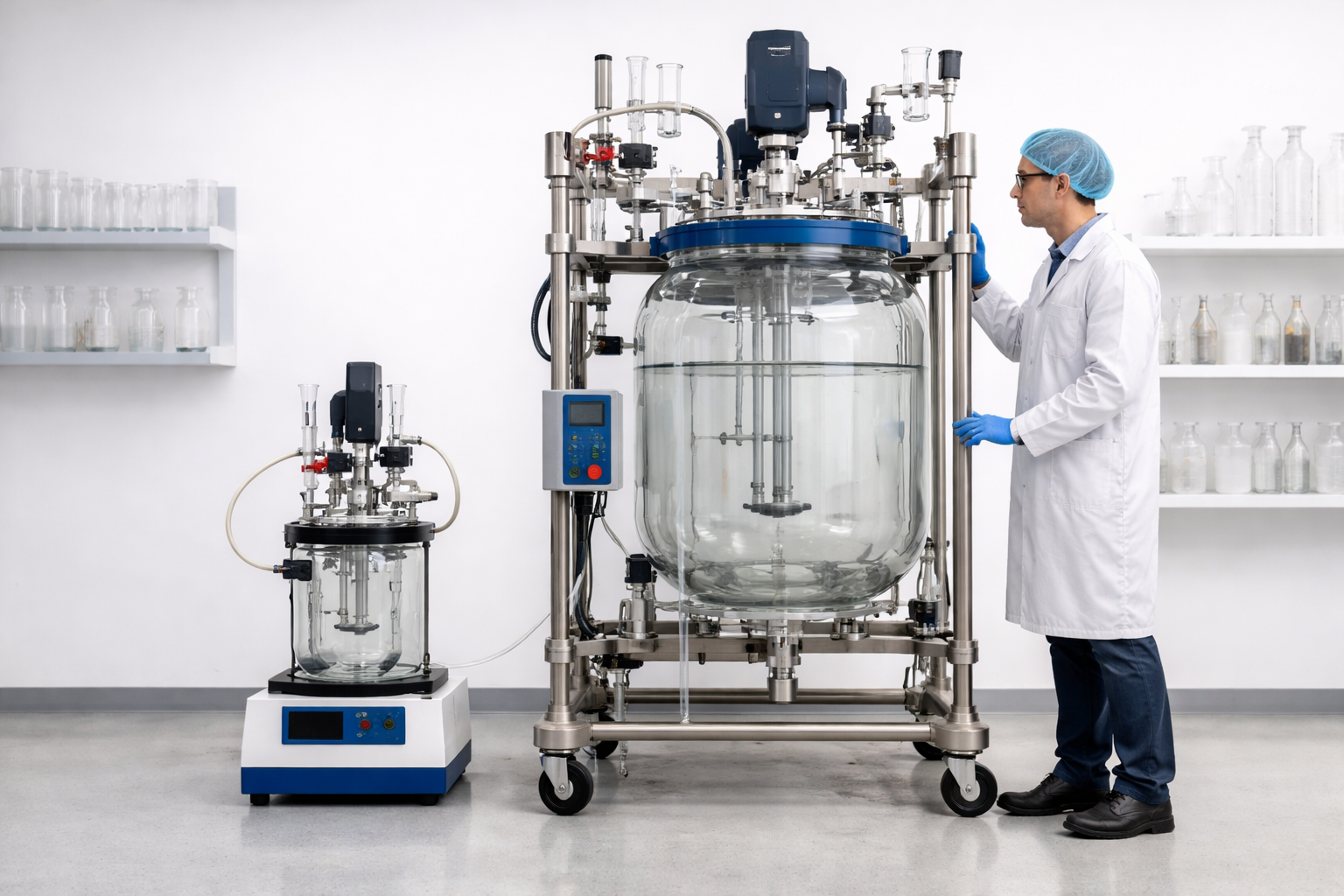
A practical, engineering-first framework for selecting glass reactor systems during scale-up—because the problems that kill pilot campaigns are rarely about chemistry.
KEY TAKEAWAYS
TL;DR — What You Need to Know
- Surface-area-to-volume ratio drops sharply as glass reactors grow larger. A 1L vessel has roughly 30 cm² of jacket area per liter of batch; at 100L, that number can fall below 8 cm²/L. This is the root cause of most scale-up thermal problems.
- Stirrer geometry that works perfectly at 2L often creates dead zones, excessive shear, or vortexing at 50L and above. Match impeller type to your fluid’s viscosity at reaction temperature, not at ambient.
- The decision between single-jacket, double-jacket, and custom configurations is a thermal engineering choice—not a purchasing one. Get it wrong and you will spend six months troubleshooting a controller that was never the problem.
- Standard off-the-shelf sizes leave gaps. If your process sits between catalog options, a custom glass reactor eliminates the compromises that delay campaigns.
Introduction
There is a moment in every scale-up project that separates seasoned engineers from optimistic ones: the first batch in a larger reactor that behaves nothing like the bench.
I have watched teams spend weeks debugging a temperature controller when the actual problem was 40% less jacket surface area per liter of batch volume. I have seen crystallizations fail at 50L because nobody recalculated the impeller Reynolds number after switching from a 3L flask. These are not edge cases. According to published process development literature, thermal and mixing deficiencies account for the majority of pilot-scale deviations that are initially misattributed to chemistry or raw material variation.
Glass reactor scale-up is not about buying a bigger version of what worked on the bench. It is about understanding which physical parameters change non-linearly with volume—and designing around them before the first batch.
This guide provides a decision framework for process engineers and lab managers selecting glass reactor systems in the 1L to 100L range. It covers the physics that actually matters, the comparison points that procurement documents usually miss, and the specific situations where a custom reactor saves more time than it costs.
What Is Glass Reactor Scale-Up?
Glass reactor scale-up is the engineering process of transferring a chemical reaction or process from a small laboratory glass vessel (typically 0.5–5L) to a larger glass reactor system (10–100L or beyond), while preserving critical process parameters such as temperature profiles, mixing quality, mass transfer rates, and product quality.
Unlike simply increasing vessel size, true scale-up requires recalculating heat transfer capacity, agitation dynamics, and instrumentation response to account for the non-linear relationship between reactor geometry and process performance.
Knowledge Card
| Parameter | What Changes During Scale-Up |
|---|---|
| Surface-area-to-volume ratio (A/V) | Decreases—the core thermal challenge |
| Impeller Reynolds number (Re) | Must be re-evaluated for each vessel size |
| Heat transfer coefficient (U) | Affected by jacket flow regime and wall thickness |
| Mixing time | Increases non-linearly with volume |
| Sensor response lag | Grows with vessel size and insertion depth |
Why Does Scale-Up Go Wrong? The Physics You Cannot Ignore
Most glass reactor scale-up failures trace back to one fundamental geometric fact: volume grows with the cube of the linear dimension, but surface area grows only with the square.
A 1L cylindrical glass reactor might have roughly 30 cm² of jacketed surface area per liter of batch. Scale that geometry to 100L, and the ratio can drop to 7–8 cm²/L. That is a 70–75% reduction in your thermal control surface per unit of reaction mass.
This means:
- Exothermic reactions that were effortlessly cooled at 2L now overshoot at 50L—not because the controller is slow, but because the jacket physically cannot remove heat fast enough.
- Heating ramp rates drop. A jacket that brought 2L of solvent from 20°C to reflux in 8 minutes may need 45 minutes for the same solvent at 80L.
- Temperature uniformity degrades. Without adequate mixing, thermal gradients develop between the vessel wall and the bulk fluid.
This is not theoretical. Any process engineer who has run the same reaction at bench and pilot scale has felt this shift firsthand. The question is whether you plan for it or discover it mid-campaign.
How to Scale a Glass Reactor System: A 7-Step Decision Framework
Step 1: Calculate your thermal duty before choosing a vessel size
Start with the heat of reaction (ΔH_rxn) and the maximum heat generation rate (q_max). Calculate the required jacket heat transfer area using the standard equation:
q = U × A × ΔT
Where U is the overall heat transfer coefficient (typically 150–350 W/m²·K for glass-jacketed systems with turbulent flow), A is the jacket surface area, and ΔT is the temperature difference between the jacket fluid and the batch.
If the required A exceeds what a standard vessel provides at your target volume, you need either a double-jacket design or a custom vessel geometry—not a bigger circulator.
Step 2: Re-evaluate stirrer geometry for the target volume
A pitched-blade turbine that delivers excellent axial flow at 2L may produce inadequate bulk circulation at 60L. The impeller-to-vessel diameter ratio (D/T) should typically remain between 0.3 and 0.5.
For viscous media above 500 mPa·s at reaction temperature, consider switching to an anchor or helical ribbon impeller. Standard catalog stirrers are designed for water-like viscosities. If your process involves slurries, suspensions, or polymer solutions, a custom stirrer design matched to your fluid rheology is worth the investment.
Step 3: Select the jacket configuration deliberately
| Jacket Type | Best For | Limitation |
|---|---|---|
| Single jacket | Moderate thermal loads, steady-state processes | Limited ramp rate, potential flow channeling |
| Double jacket (baffled) | Fast heating/cooling, exothermic reactions | Higher cost, more complex plumbing |
| Half-pipe coil jacket | High heat flux, viscous jacket fluids | Not standard on glass; available in glass-lined steel |
| Custom zoned jacket | Multi-zone temperature control, crystallization | Requires engineering input from the manufacturer |
The choice between single and double jacket is an engineering decision, not a budget one. For any reaction with a heat release rate above approximately 50 W/L, a double-jacket configuration significantly improves safety margins and process control.
Step 4: Plan port configuration for flexibility
At bench scale, a 4-port lid handles most needs. At 20L and above, you will want at least 6–8 ports to accommodate:
- Temperature probe (PT100 or thermocouple)
- Dosing inlet (liquid addition funnel or pump line)
- Reflux condenser connection
- Nitrogen or inert gas inlet
- Sampling port
- Spare port for future instrumentation (pH, FBRM, Raman)
Retrofitting glass reactor lids is expensive and introduces risk. Specify more ports than you need today. It is far cheaper than re-engineering mid-campaign.
Step 5: Match the bottom outlet valve to your product
At 1L, you decant or pipette. At 20L and above, a bottom outlet valve is essential. For slurries and crystal suspensions, a full-bore valve with PTFE seal prevents bridging and allows gravity discharge. For clean liquids, a standard stopcock may suffice.
This detail is overlooked in an astonishing number of scale-up projects. A poorly chosen drain valve can add 30 minutes of manual work to every batch turnaround.
Step 6: Verify instrumentation response at the new scale
PT100 sensors that respond within seconds in a 2L vessel may exhibit 15–30 second lag in a 100L system due to increased insertion depth and thermal mass. Factor this lag into your control loop tuning.
If you use a digital temperature controller, recalibrate PID parameters for the new vessel—do not copy settings from the bench system.
Step 7: Run a solvent-only shakedown before introducing chemistry
Fill the reactor to working volume with your process solvent. Run agitation, heating, and cooling cycles. Verify:
- Jacket ramp rate meets your process requirements
- No shaft wobble or seal overheating at operating speed
- All sensor readings are stable and within specification
- Condenser capacity handles full reflux at target temperature
This step takes half a day and prevents weeks of troubleshooting later.
Standard vs. Custom Glass Reactors: When Does Customization Pay Off?
Not every scale-up needs a custom reactor. But the gaps between standard catalog sizes create real problems when your process does not fit neatly into a 10L, 20L, 50L, or 100L vessel.
| Scenario | Standard Off-the-Shelf | Custom Design |
|---|---|---|
| Batch size fits a catalog volume | ✅ Fast procurement, proven design | Unnecessary added cost |
| Process needs unusual aspect ratio (e.g., tall and narrow for gas-liquid contact) | ❌ Forces compromise on mixing or headspace | ✅ Optimized geometry for your specific process |
| Thermal duty exceeds single-jacket capacity | ❌ Requires oversized circulator or longer cycle times | ✅ Double-jacket or zoned design matched to thermal profile |
| Non-standard port configuration | ❌ Retrofitting introduces leak points | ✅ Purpose-built lid with all ports from day one |
| Viscous or solid-containing product | ❌ Standard stirrers and valves may underperform | ✅ Custom agitator geometry and full-bore bottom valve |
| Regulatory traceability required (pharma, API) | Possible with documentation add-ons | ✅ Full material certification, IQ/OQ documentation included |
The real cost of a mismatched standard reactor is not the purchase price—it is the months of troubleshooting, failed batches, and delayed process transfer. For processes with demanding thermal profiles, unusual geometries, or strict regulatory requirements, a custom glass reactor designed around your actual process data is frequently the faster path to production.
Counterpoint: When Bigger Is Not Better
Not every process benefits from scaling in a single vessel. Some reactions are better served by running multiple smaller reactors in parallel or by keeping the reactor volume small and increasing throughput through faster cycle times.
Consider parallel operation when:
- Mixing-sensitive reactions lose selectivity above a critical volume
- Crystallization processes require precise cooling profiles that large jackets cannot deliver uniformly
- Regulatory strategy favors identical small-scale batches (common in early-phase pharma manufacturing)
The decision is process-specific. But it should be made consciously, not by default.
FAQ — Glass Reactor Scale-Up
What is the biggest challenge when scaling a glass reactor from 1L to 100L?
The single biggest challenge is the reduction in surface-area-to-volume ratio, which directly limits heat removal and addition capacity. A 100L vessel may have only 25–30% of the specific jacket area (per liter) that a 1L vessel offers. This makes thermal control harder, ramp rates slower, and exothermic reactions more difficult to manage safely.
Engineers should calculate thermal duty explicitly before selecting a vessel size, rather than assuming the same reaction conditions will transfer directly.
Can I use the same stirrer type at 100L that I used at 1L?
Usually not. Impeller performance depends on the Reynolds number, which changes with vessel diameter and fluid depth. A pitched-blade turbine that produces turbulent flow at 2L may generate transitional or even laminar flow patterns in a 50L vessel at the same RPM. Agitator geometry should be re-evaluated at each scale, ideally with input from the reactor manufacturer.
How do I decide between single-jacket and double-jacket glass reactors?
Base the decision on your process thermal demand, not on budget. If your reaction generates or requires heat flux above approximately 50 W/L, or if you need heating/cooling ramp rates faster than 1–2°C per minute at the target batch size, a double-jacket design provides significantly better performance and safety margin.
For steady-state processes with moderate thermal loads, a single jacket is adequate and simpler to operate.
At what scale does a custom glass reactor make sense over standard catalog sizes?
Custom design becomes cost-effective when your process requires non-standard vessel geometry, specialized port configurations, unusual stirrer designs, or jacket capacity that exceeds what standard vessels offer. In practice, this threshold often appears around 20–30L, where the diversity of process requirements increases and standard configurations start forcing compromises.
For pharmaceutical API development with GMP documentation needs, custom reactors with full material traceability often simplify validation significantly.
How much does the heat transfer coefficient change between 1L and 100L glass reactors?
The overall heat transfer coefficient (U) itself does not change dramatically with scale—it depends primarily on jacket flow regime, fluid properties, and wall thickness. What changes is the available surface area per unit volume. Combined with any shift from turbulent to laminar jacket flow in larger vessels (if circulation rate is not increased proportionally), effective thermal performance can drop by 50–70% from bench to pilot scale.
Ensuring turbulent flow in the jacket (Reynolds number > 10,000 on the jacket side) is one of the most impactful—and most overlooked—scale-up interventions.
Conclusion
Glass reactor scale-up is a geometry problem disguised as a chemistry problem. The reaction does not change. The physics around it does.
Engineers who calculate thermal duty, re-evaluate agitation, and select jacket design based on process data—rather than catalog availability—avoid the months of troubleshooting that consume most pilot campaigns. And when the process sits between standard sizes or demands something a catalog vessel cannot deliver, a custom glass reactor designed around actual process requirements is not a luxury. It is the engineering-correct decision.
If you are planning a scale-up from bench to pilot, start with the thermal math. Everything else follows from there.
Request a scale-up consultation with HWS engineers →
Author Bio
Dr. Jürgen Haas, PhD, is a Senior Chemical Engineer with over 15 years of experience in R&D, scale-up, and pilot plant operations across fine chemicals and pharmaceutical development. He specializes in glass reactor systems, process safety, and the technical challenges of translating laboratory chemistry into production-ready processes.