
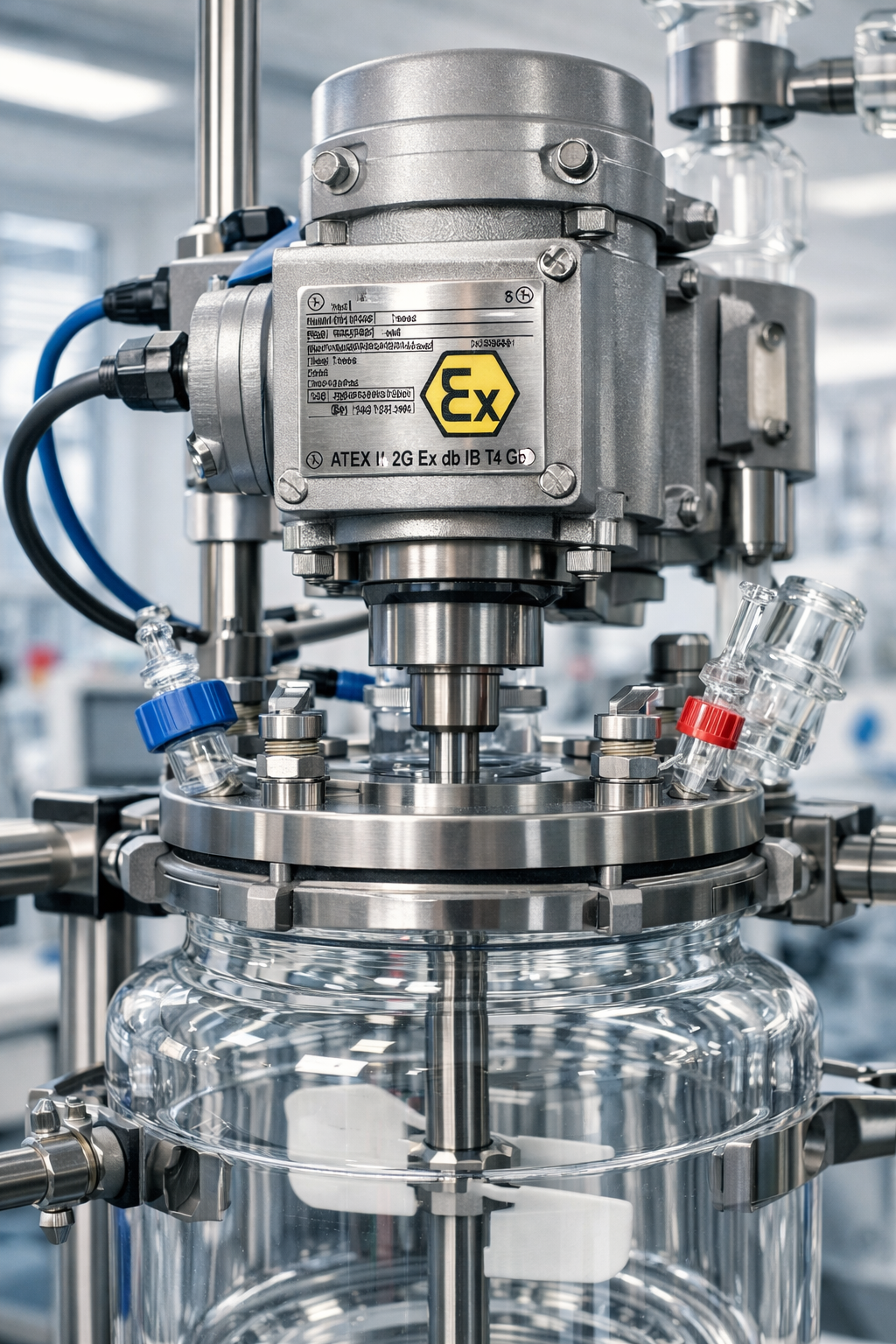
A clear, no-jargon guide to ATEX zone classification and explosion-proof requirements for glass reactor systems — written for the engineers who have to pass the audit, not the consultants who write the standards.
KEY TAKEAWAYS
TL;DR — What You Need to Know
- ATEX is not optional if your glass reactor handles flammable solvents in the EU. Two directives govern this space: 2014/34/EU for equipment manufacturers and 1999/92/EC for employers who operate equipment in hazardous zones.
- Most pharma and chemical R&D labs working with volatile solvents fall into ATEX Zone 1 or Zone 2 around the reactor itself. The zone determines which equipment category you need — and getting this wrong is an audit failure, not a technicality.
- The stirrer motor is the single most critical component for ATEX compliance in a glass reactor system. Standard electric motors are ignition sources. Explosion-proof (Ex d), increased safety (Ex e), or pneumatic drives are the options — each with different trade-offs.
- Glass itself is not the ATEX problem. The electrical and mechanical components attached to the glass vessel are what need certification. Specify these correctly from the start, and compliance becomes straightforward.
Introduction
Here is a situation that plays out more often than it should: a lab installs a new glass reactor system, runs three successful campaigns with flammable solvents, and then fails a safety inspection because the stirrer motor is not ATEX-rated for the classified zone.
The equipment works perfectly. The chemistry is fine. But the facility is non-compliant, and production stops until the motor is replaced, the electrical assessment is updated, and the documentation is corrected. Two weeks of downtime, easily. Sometimes more.
I have seen this happen in pharma R&D labs, pilot plants, and kilo-lab facilities across Germany, Switzerland, and the Netherlands. The pattern is almost always the same: the glass vessel gets all the attention during procurement, while the explosion-proof requirements for the electrical and mechanical components get treated as an afterthought.
This guide explains what ATEX compliance means in practice for glass reactor systems in European laboratories. Not the full regulatory text — you can read the directives for that — but the practical decisions that determine whether your installation passes an audit or creates a six-figure problem.
What Is an Explosion-Proof Glass Reactor?
An explosion-proof glass reactor is a glass reactor system in which all electrical, mechanical, and control components are designed, certified, and installed to prevent ignition of flammable gases, vapors, or dusts in the surrounding atmosphere. In the European Union, this compliance is governed by the ATEX directives, specifically Directive 2014/34/EU for equipment placed on the market and Directive 1999/92/EC for workplace safety.
The term “explosion-proof” does not mean the equipment can survive an explosion. It means the equipment is designed so that it cannot become the source of ignition in an environment where explosive atmospheres may be present.
Knowledge Card: ATEX at a Glance
| Term | Meaning |
|---|---|
| ATEX | From the French “ATmosphères EXplosibles” — EU regulatory framework for explosive atmospheres |
| Directive 2014/34/EU | Product directive — governs what manufacturers must certify before selling equipment |
| Directive 1999/92/EC | Workplace directive — governs how employers classify zones and protect workers |
| Ex marking | The hexagonal “Ex” symbol indicating ATEX-certified equipment |
| Zone classification | Rating system (Zones 0, 1, 2 for gas; 20, 21, 22 for dust) based on likelihood of explosive atmosphere |
| Equipment Category | Categories 1, 2, 3 — tied to the protection level required for a given zone |
How Are ATEX Zones Classified Around a Glass Reactor?
ATEX zone classification around a glass reactor depends on the probability and duration of a flammable atmosphere being present during normal operations. The classification is the employer’s responsibility under Directive 1999/92/EC, typically carried out with support from a safety engineer.
Here is what this looks like in practice for a typical glass reactor installation handling volatile organic solvents:
Typical Zone Map for a Lab Glass Reactor
| Location | Typical Zone | Rationale |
|---|---|---|
| Inside the glass vessel (during solvent-based reactions) | Zone 0 | Flammable vapor is present continuously during operation |
| Immediate vicinity of vessel openings, flanges, and seals (within ~1 m) | Zone 1 | Vapors are likely to escape occasionally during normal operations (dosing, sampling, reflux) |
| Surrounding lab area beyond 1 m, with adequate ventilation | Zone 2 | Explosive atmosphere unlikely under normal conditions, but possible during spills or leaks |
| Control panel and data logging area (separate from reactor, well-ventilated) | Non-hazardous | No explosive atmosphere expected |
The exact boundaries depend on your specific facility layout, ventilation rates, and the flash points of the solvents you use. A lab routinely running reactions with diethyl ether (flash point –45°C) will have more conservative zone boundaries than one using DMSO (flash point 89°C).
The critical insight: equipment placed inside a zone must be certified for that zone’s category. A standard electric motor in Zone 1 is a compliance violation — period.
How to Specify an ATEX-Compliant Glass Reactor System: A Step-by-Step Approach
Step 1: Commission a hazardous area classification
Before purchasing any equipment, have a qualified safety engineer classify the zones around your planned reactor installation. This assessment considers room ventilation, solvent flash points, vessel opening frequency, and extraction capacity. The output is a zone map — the foundation for all equipment decisions.
Step 2: Identify which reactor components fall within classified zones
The glass vessel itself is chemically inert and does not generate sparks, heat, or static under normal conditions. Glass is not the ATEX concern. The components that require ATEX certification are:
- Stirrer motor (the primary ignition risk — electric motors can spark, overheat, or arc)
- Frequency converter / variable speed drive (if located within the zone)
- Temperature sensors and transmitters (if electrically powered within the zone)
- Lighting near the reactor (if within the zone boundary)
- Solenoid valves on dosing or drain lines (if electrically actuated within the zone)
- Level sensors or pressure transducers (if electronic, within the zone)
Step 3: Select the right explosion protection method for the stirrer drive
The stirrer motor is where most ATEX decisions for glass reactors are made. There are three common approaches:
| Protection Method | ATEX Marking | How It Works | Best For |
|---|---|---|---|
| Flameproof enclosure (Ex d) | Ex d IIB T4 | Motor is enclosed so internal explosion cannot propagate outward | High-torque applications, pilot-scale reactors where power matters |
| Increased safety (Ex e) | Ex e IIB T4 | Motor is designed to prevent sparks and excessive temperatures under normal and specified abnormal conditions | Lower-torque lab reactors where simplicity and cost matter |
| Pneumatic (air-driven) motor | No electrical ignition source | Eliminates the electrical risk entirely; compressed air drives the agitation | Highest safety requirement; Zone 0-adjacent applications or labs wanting to avoid electrical certification entirely |
Each approach has trade-offs. Flameproof motors are heavy and expensive but deliver full torque control with variable frequency drives. Pneumatic motors are inherently safe but offer less precise speed control and require an air supply infrastructure.
For most pharma and chemical R&D glass reactors in Zone 1 environments, Ex d or Ex e motors with Category 2 certification cover the regulatory requirement. For pilot plants with Zone 0 interiors and Zone 1 surroundings, the manufacturer must provide Category 1 equipment for any component inside the vessel space.
Step 4: Verify the temperature class matches your solvents
Every ATEX-certified component carries a temperature class (T1 through T6) indicating the maximum surface temperature the equipment can reach. This must be below the auto-ignition temperature of the solvents used.
| Temperature Class | Max Surface Temp | Common Solvents Below This Threshold |
|---|---|---|
| T1 | 450°C | Most common lab solvents (acetone, ethanol, toluene) |
| T2 | 300°C | Ethanol, methanol, acetone, xylene |
| T3 | 200°C | Diesel fuel, kerosene, some higher alcohols |
| T4 | 135°C | Diethyl ether (auto-ignition 160°C), acetaldehyde |
| T5 | 100°C | Carbon disulfide (auto-ignition 90°C — requires T6) |
| T6 | 85°C | Carbon disulfide |
T4 is the standard specification for most glass reactor installations in pharma and fine chemical labs. If you regularly work with carbon disulfide, specify T6 — but this significantly limits motor availability.
Step 5: Request and archive the documentation
For ATEX compliance, you need:
- EU Declaration of Conformity for each ATEX-certified component (manufacturer’s responsibility under Directive 2014/34/EU)
- Ex certificate issued by a Notified Body (for Category 1 and 2 equipment)
- Technical documentation including the hazardous area classification, equipment specifications, and installation drawings
- Explosion Protection Document for your facility (employer’s responsibility under Directive 1999/92/EC)
Auditors check documentation first. If you cannot produce these documents within minutes of being asked, the inspection has already gone sideways.
What Auditors Actually Check: Common Failure Points
Having sat through facility audits and supported remediation projects after failed inspections, I can say that the same issues appear repeatedly. Glass reactor ATEX non-conformities rarely involve exotic edge cases. They involve basics:
| Common Failure | Why It Happens | How to Prevent It |
|---|---|---|
| Standard (non-Ex) motor on reactor in Zone 1 | Motor was specified by the procurement team, not the safety engineer | Include zone classification in the equipment specification from day one |
| Missing or expired Ex certificate for motor or controller | Documentation was not requested at purchase, or the Notified Body certificate lapsed | Request certificates before delivery; calendar renewal dates |
| Temperature class mismatch — T2 motor used with T4-required solvents | Solvent list changed after installation; nobody re-checked the motor rating | Maintain a live solvent register linked to equipment temperature class |
| Zone boundary not documented — no explosion protection document on file | Lab was classified informally; no written assessment exists | Commission a formal hazardous area classification before first use |
| Non-Ex lighting or sensors within the classified zone | Overlooked during initial setup; assumed to be “outside the zone” | Map every electrical component against the zone drawing during commissioning |
| Modifications made without updating ATEX documentation — e.g., adding a dosing pump | Change was treated as minor; no re-assessment performed | Implement a management-of-change procedure that triggers ATEX review |
Counterpoint: When Full ATEX Compliance May Not Be Required
Not every glass reactor installation needs explosion-proof equipment. If your lab exclusively handles non-flammable solvents (e.g., water, aqueous buffers, DMSO above its flash point in a well-ventilated environment), the area may classify as non-hazardous, and standard equipment is acceptable.
Similarly, labs using fume hoods with high extraction rates may be able to reduce the extent of Zone 1 around the reactor, potentially placing the motor and controls in a Zone 2 or non-hazardous area. This is a legitimate engineering control — but it must be documented in the hazardous area classification. “Our fume hood is pretty strong” does not pass an audit. A measured air velocity with a documented extraction rate does.
The decision tree is: classify first, specify equipment second. Never the other way around.
FAQ — ATEX and Explosion-Proof Glass Reactors
Does the glass vessel itself need ATEX certification?
No. Borosilicate glass is chemically inert, non-conductive, and does not generate ignition-capable energy under normal conditions. The glass vessel does not require ATEX certification. However, all attached electrical and mechanical components — stirrer motors, sensors, lighting, actuators — within the classified zone must be ATEX-certified.
The vessel’s role in ATEX is as a containment boundary. If it is sealed properly, it limits vapor release and reduces zone extent.
What ATEX zone does a typical R&D glass reactor lab fall into?
Most R&D and kilo-lab environments handling volatile organic solvents classify as Zone 1 in the immediate vicinity of the reactor (within approximately 1 meter) and Zone 2 in the broader lab area with adequate ventilation. The interior of the vessel during solvent-based reactions is typically Zone 0.
Exact zone boundaries depend on room ventilation rates, solvent volatility, and the frequency of vessel openings during operation.
Is an ATEX-rated motor always required for a glass reactor stirrer?
Only if the motor is located within a classified ATEX zone. If your hazardous area classification places the motor outside any zone — for example, by using a long stirrer shaft with the motor mounted above the zone boundary, or by ensuring sufficient ventilation to eliminate the zone at motor height — a standard motor may be acceptable. This approach requires formal documentation in the explosion protection document.
In practice, for most glass reactor setups where the motor sits directly on the vessel lid, it will be within Zone 1, and an ATEX-certified drive is required.
What is the difference between ATEX and IECEx for glass reactors?
ATEX is the EU regulatory framework (mandatory for equipment sold and used within the EU/EEA). IECEx is an international certification system that is not legally mandatory in any jurisdiction but is widely accepted globally. Equipment with both certifications can be sold in the EU and in countries that recognize IECEx (Australia, Brazil, South Korea, and others).
For European labs, ATEX certification is the legal requirement. IECEx is a bonus for manufacturers who sell globally.
How much does an ATEX-compliant glass reactor system cost compared to a standard one?
The glass vessel itself costs the same. The price increase comes from ATEX-certified components, primarily the stirrer motor, variable frequency drive, and sensors. As a rough benchmark, an Ex d-rated stirrer drive adds 30–60% to the motor cost compared to a standard equivalent, and the overall system premium for full ATEX compliance typically ranges from 15–25% above a non-Ex configuration.
The cost of non-compliance — equipment replacement, production downtime, audit remediation, and potential regulatory penalties — is substantially higher.
Conclusion
ATEX compliance for glass reactor systems is not a glass problem — it is an electrical and documentation problem. The vessel is inert. The motor, the sensors, the actuators, and the paperwork are where compliance lives or dies.
The engineers and lab managers who get this right share a common approach: they classify the hazardous area before writing the equipment specification, they select ATEX-rated components matched to the zone and temperature class, and they archive every certificate and declaration from day one.
If you are specifying a glass reactor for a European lab that handles flammable solvents, start with the zone classification. Everything else — motor type, temperature class, documentation package — flows from that single decision.
Discuss ATEX-compliant reactor configurations with HWS engineers →
Author Bio
Dr. Jürgen Haas, HWS Labortechnik, holds a Doctorate in Chemical Engineering with over 30 years of experience in laboratory glass reactor systems for pharmaceutical process development. Dr. Haas works with R&D and pilot-plant teams across Europe to consult reactor configurations optimized for temperature-sensitive processes including crystallization, distillation, and API synthesis.
Published by HWS Labortechnik Mainz — Specialists in Custom Glass Reactor Systems for Laboratories and Pilot Plants since 1941.