
Key takeaways
- Separate filtration is simple, but it can become inefficient when transfers are slow, messy or sensitive to air and moisture.
- Integrated filtration can reduce handling steps in multi-step synthesis, crystallization and process development workflows.
- The right setup depends on slurry behavior, solvent compatibility, temperature, vacuum or inert gas requirements and cleaning needs.
- Filtration should be specified together with the reactor, stirring, dosing, bottom outlet and receiving setup, not treated as an isolated accessory.
- HWS develops custom glass reactor and filtration systems for laboratories that need practical equipment adapted to the process.
Introduction
Filtration is often treated as a secondary operation in the laboratory. The reactor is selected first, the stirring system is discussed in detail, dosing points are planned, temperature control is specified, and only later does someone ask: “How will we separate the solid from the liquid?”
For simple workups, that may be acceptable. A Büchner funnel, filter flask or separate filtration unit can be enough. But in pharmaceutical R&D, fine chemical development and multi-step synthesis, filtration can become one of the most time-consuming and failure-prone parts of the workflow.
The problem is not only filtration speed. It is transfer loss, exposure to air or moisture, blocked filters, difficult cleaning, poor containment, temperature changes during transfer and poor reproducibility between experiments. When these problems appear repeatedly, laboratories should consider whether filtration belongs inside the reactor workflow rather than outside it.
The technical background
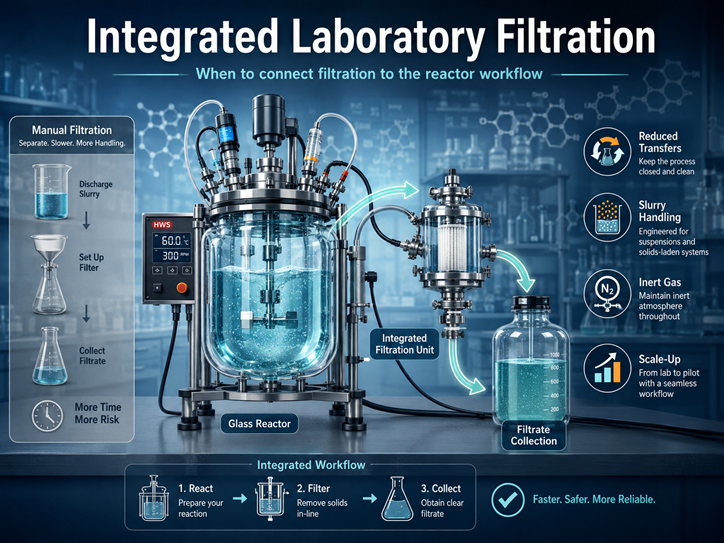
Integrated laboratory filtration means that the filtration step is planned as part of the overall glass reactor system. Instead of moving the reaction mixture manually to a completely separate setup, the process can be designed so that filtration is connected to the reactor, receiving vessel, vacuum source, inert gas supply or downstream processing step.
This can be relevant in several common workflows:
- crystallization followed by mother liquor separation
- catalyst removal after hydrogenation or other catalytic reactions
- removal of salts or inorganic by-products
- filtration during multi-step synthesis without full disassembly
- handling of air-sensitive or moisture-sensitive intermediates
- solvent exchange and washing operations
- process development studies where the same filtration logic must later be scaled
In glass process equipment, the advantage is visibility. Chemists can observe slurry behavior, cake formation, liquid clarity, gas bubbles, foaming and transfer behavior directly. But visibility does not solve poor specification. If the filter area, connection geometry, valve arrangement or receiving side is wrong, the system will still be frustrating to use.
The decision problem
The key question is not “Do we need a filter?” The better question is:
Does filtration need to be part of the controlled process, or is it only a final workup step?
If filtration is only occasional and non-critical, a separate setup may be more economical. If filtration affects yield, purity, reproducibility, safety or operator workload, integration becomes much more attractive.
| Decision factor | Separate filtration may be enough | Integrated filtration may be better |
|---|---|---|
| Frequency | Occasional use | Repeated workflow step |
| Material sensitivity | Stable in air | Air-sensitive or moisture-sensitive |
| Transfer losses | Low concern | Expensive or low-yield product |
| Slurry behavior | Easy to pour and filter | Settling, clogging, viscous or difficult slurry |
| Process development | One-off experiment | Repeatable procedure or scale-up study |
| Cleaning | Simple glassware cleaning | Need defined cleaning access and fewer transfers |
| Containment | Low-risk material | Odorous, irritating or sensitive compounds |
This decision is especially important in process development. A filtration method that works once at flask scale may become a bottleneck at 5 L, 10 L or pilot scale. If the development team wants useful scale-up data, filtration behavior should be studied with equipment that reflects the intended process logic.
Main options for laboratory filtration workflows
1. Separate manual filtration
This is the simplest option. The reaction mixture is transferred to a funnel or separate filtration apparatus after the reaction is complete.
It is flexible, inexpensive and easy to understand. It also requires manual transfer, which may introduce losses, exposure and variability. For robust materials and small volumes, this is often acceptable.
2. Reactor discharge to a connected filtration unit
In this configuration, the reactor is fitted with a suitable outlet and connected to a filtration unit or receiving setup. The operator can discharge the mixture in a more controlled way.
This approach can reduce handling and improve workflow consistency. It requires attention to outlet design, dead volume, valve selection, slurry flow and cleaning access.
3. Filtration under inert gas
Some products or intermediates should not be exposed to oxygen or moisture. In these cases, filtration may require nitrogen or argon blanketing, suitable connections and a receiving setup that maintains the desired atmosphere.
This is not something to improvise at the end of the project. If inert handling is required, it should be specified at the beginning.
4. Process-specific custom filtration setup
Some workflows need a modified or fully custom solution. Examples include difficult slurries, unusual vessel geometry, multiple washing steps, temperature-sensitive crystallization, integration with dosing or distillation, or restricted laboratory space.
For these cases, standard catalogue components may provide the basis, but the final system should be engineered around the application.
Practical implementation considerations
Before selecting an integrated filtration setup, the laboratory should define the process requirements clearly.
Step-by-step specification checklist
- Define the process goal
Is the purpose clarification, product isolation, catalyst removal, salt removal, washing, solvent exchange or intermediate transfer?
- Describe the slurry
Particle size, viscosity, settling behavior and tendency to clog matter more than the nominal reactor volume.
- Clarify the working volume
Consider realistic operating volume, not only maximum vessel size. Filtration performance depends on the actual amount of solid and liquid handled.
- Check chemical compatibility
Borosilicate glass 3.3 is highly chemically resistant, but not universal. Seals, valves, filter media and tubing must also be considered.
- Define temperature conditions
Some filtrations must happen hot, cold or after controlled crystallization. Temperature changes during transfer can affect viscosity, solubility and cake behavior.
- Specify vacuum or inert gas requirements
Do not assume that every component is suitable for every vacuum, pressure or gas-handling scenario. Requirements should be stated explicitly.
- Plan cleaning and disassembly
A technically clever setup is not useful if it is hard to clean, inspect or reassemble.
- Consider future scale-up
If the process may move to larger volumes, the filtration concept should generate meaningful process knowledge.
Where HWS fits
For laboratories that need more than a standard catalogue setup, HWS develops custom glass reactor systems, filtration units and laboratory process equipment adapted to the customer’s workflow.
This can include glass reactor assemblies, vessel and lid configurations, bottom outlet solutions, filtration units, inert gas connections, stirring systems, dosing accessories, condensers, receiving vessels, support frames and related laboratory components.
The most useful role for HWS is often at the specification stage. Instead of selecting filtration as a late accessory, the reactor, outlet, filter, receiving side and supporting structure can be discussed as one workflow. This helps avoid systems that look complete on paper but are awkward in daily laboratory use.
Final configuration depends on the customer’s chemistry, volume, solids loading, operating conditions, cleaning requirements and available laboratory space.
Common mistakes
1. Treating filtration as an afterthought
If filtration affects yield, purity or cycle time, it should be included in the equipment concept from the beginning.
2. Choosing by reactor volume only
A 5 L reactor does not automatically define the correct filter size. Solid loading, cake resistance and washing steps may be more important.
3. Ignoring slurry transfer behavior
Some slurries do not flow easily through narrow outlets or long connections. Valve geometry and discharge path matter.
4. Forgetting the atmosphere requirement
If the material is oxygen-sensitive or moisture-sensitive, the filtration and receiving setup must support that requirement.
5. Overcomplicating a simple process
Not every lab needs integrated filtration. If the process is simple, robust and low-frequency, separate filtration may remain the best choice.
6. Not planning cleaning access
Laboratory equipment must be usable after the first experiment. Cleaning, inspection and spare part access are practical requirements, not details.
Conclusion
Integrated filtration is not automatically better than separate filtration. It is better when filtration is a controlled part of the process rather than a simple final workup.
For pharmaceutical R&D, chemical process development and multi-step synthesis, the strongest reasons to integrate filtration are reduced transfers, better handling of sensitive materials, improved reproducibility and a clearer path toward scale-up.
The best results come when filtration is specified together with the reactor system, not added at the end. Laboratories should define the chemistry, slurry behavior, volume, atmosphere, temperature and cleaning requirements before selecting the equipment.
HWS can support laboratories with custom glass reactor and filtration systems designed around these practical process requirements.
FAQ
What is integrated laboratory filtration?
Integrated laboratory filtration means the filtration step is planned as part of the reactor workflow, often using connected glass equipment, valves, receiving vessels, vacuum or inert gas connections.
When is integrated filtration better than separate filtration?
It is usually better when transfers are difficult, the material is sensitive to air or moisture, filtration affects yield or purity, or the workflow must be repeated consistently during process development.
Can glass filtration systems be used for air-sensitive compounds?
They can be configured for inert gas handling in suitable cases, but the requirement must be specified clearly. The final design depends on the chemistry, equipment connections and operating conditions.
Is borosilicate glass suitable for all chemicals?
No. Borosilicate glass 3.3 is highly chemically resistant, but it is not universally compatible. Hydrofluoric acid, very hot phosphoric acid and alkaline solutions can attack glass surfaces. Seals and accessories must also be checked.
Should filtration be specified before or after reactor selection?
For simple workflows, it may be specified later. For process development, sensitive chemistry or repeated multi-step workflows, filtration should be considered during reactor system design.
Can HWS build custom filtration systems?
HWS develops custom glass reactor systems, filtration units and laboratory process equipment. Final configuration depends on the customer’s process, volume, solids loading, operating conditions and workflow requirements.