
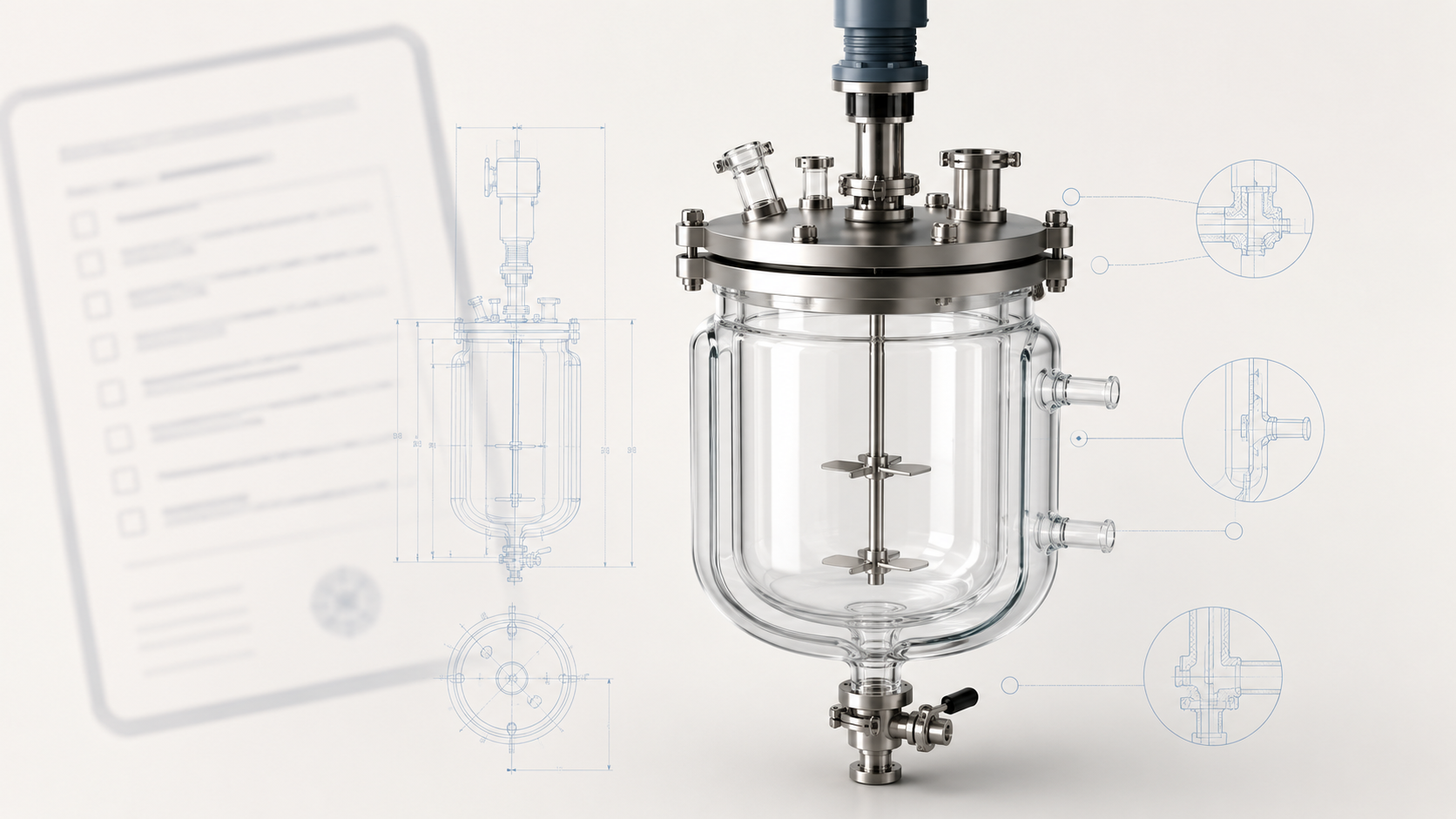
A practical framework for translating GMP requirements into a glass reactor specification that will survive qualification, audit, and routine production.
TL;DR / Key Takeaways
- “GMP-compliant” is not a property you can buy off a label — it is a property of the whole system: materials, design, documentation, and how the reactor is qualified and operated.
- The load-bearing decisions are made early, in the User Requirements Specification (URS). Wetted materials, cleanability, drainability, sealing, and traceable documentation are far cheaper to design in than to retrofit.
- Borosilicate glass 3.3 is an inherently strong starting point for pharmaceutical work, but compliance depends on the complete wetted path — seals, valves, gaskets, and stirrer components included.
- Many GMP reactor projects are genuinely custom: the geometry, cleaning strategy, and instrumentation must match your process and your quality documentation, not a generic catalog entry.
Introduction
A reaction that runs cleanly on the bench is not the same thing as a reactor that will pass qualification and hold up under audit. In a regulated pharmaceutical environment, the question is no longer “does the chemistry work?” but “can we prove, on paper and in practice, that it works the same way every time, in equipment we can clean, document, and defend?”
For German process engineers, this distinction is familiar. Good Manufacturing Practice (GMP) does not reward equipment that merely functions; it rewards equipment that is specified well enough that its behaviour is predictable, traceable, and repeatable. That standard is set long before a vessel is blown — it is set when you write the specification.
This article lays out a practical framework for specifying a GMP-compliant glass reactor: what “compliant” actually means, which design decisions carry the most regulatory weight, and how to write a specification that qualification will confirm rather than contradict.
What “GMP-compliant” actually means for a glass reactor
It is worth being precise, because the phrase is often used loosely. A glass reactor is not “GMP-certified” in isolation. GMP is a framework applied to a manufacturing operation; equipment becomes compliant when it is designed, documented, qualified, and maintained so that it supports a validated process.
In practice, a GMP-compliant reactor has to satisfy four connected requirements:
- Suitable materials of construction across the entire wetted path, with documented evidence of what those materials are.
- A design that can be cleaned and verified — no hidden dead legs, drainable geometry, accessible surfaces.
- Complete, traceable documentation — material certificates, drawings, and a specification that can be tested against.
- A defined qualification route — the reactor can be taken through Design, Installation, Operational, and Performance Qualification (DQ/IQ/OQ/PQ) without surprises.
The European framework for this is set out in EU GMP Annex 15 on qualification and validation, which describes the life-cycle approach — from design through ongoing verification — that your specification should anticipate from the first line.
Materials of construction: the whole wetted path, not just the glass
Borosilicate glass 3.3 is, deservedly, the default vessel material for pharmaceutical chemistry. Its low thermal expansion, broad chemical resistance, and inert, non-shedding surface make it well suited to processes where product purity and visual control both matter. We cover its properties in more detail in our discussion of why borosilicate glass 3.3 still reigns.
The common specification mistake is to stop at the glass. A reactor’s wetted path also includes gaskets, O-rings, the stirrer shaft and blade, any dip tubes or sensors, and the sealing system where the shaft enters the vessel. Each of these contacts the product and each must be justified. For a GMP file, that means specifying elastomer grades that are documented for pharmaceutical contact, and being able to reason about extractables and leachables for the materials you have chosen.
Sealing deserves particular attention. Where a rotating shaft meets the vessel, the seal is both a containment boundary and a potential source of contamination. Specifying an appropriate mechanical seal and stirrer guide — rather than accepting a generic bushing — is often what separates a reactor that merely turns a stirrer from one that can be defended in an aseptic or contained context.
Design for cleaning: the requirement that shapes the geometry
If there is a single principle that dominates GMP equipment design, it is this: you must be able to clean it, and you must be able to prove it is clean. Cleaning is not an operational afterthought; it is a design constraint that shapes the reactor’s geometry.
Key considerations when specifying for cleanability:
- Drainability. The vessel should empty completely, without pooling. A well-designed bottom outlet valve with minimal dead volume lets the reactor discharge and drain cleanly, which matters as much for cleaning validation as for product recovery.
- Dead legs. Any branch, port, or instrument pocket that traps residue is a liability. The specification should minimise them and make the remaining ones accessible.
- Surface accessibility. Smooth, continuous internal surfaces are easier to clean and to swab for verification. Glass helps here — it is non-porous and does not shed — but nozzle transitions and fittings still need scrutiny.
- A defined cleaning strategy. Decide early whether the reactor is manually cleaned or cleaned in place (CIP), because that decision drives spray-ball placement, port design, and validation effort.
The proof step — cleaning validation — is a discipline in its own right, and one worth understanding before you finalise geometry. Our deep dive into cleaning validation for glass reactors explains how the design choices above translate into a defensible protocol.
Documentation and qualification: designing for the paper trail
In a GMP environment, undocumented is effectively the same as undone. A reactor can be physically excellent and still fail an audit if its specification, materials, and behaviour cannot be traced on paper.
Build the documentation expectation into the specification itself:
- User Requirements Specification (URS). State the process boundary conditions explicitly — temperature range, pressure, materials handled, cleaning method, and the critical quality attributes the equipment must support. The URS is the document every later qualification stage tests against.
- Material certification. Require traceable certificates for the glass and for elastomer and metal components in the wetted path.
- Qualification route. Confirm that the design can be taken through DQ/IQ/OQ/PQ. Installation and operational checks are far smoother when the reactor was designed with them in mind, as we discuss in our guide to installation and configuration of glass reactor systems.
- Risk-based rigour. Not every parameter deserves equal scrutiny. The principle of matching effort to risk comes from ICH Q9 quality risk management: focus qualification effort where a failure would most threaten product quality or patient safety.
Writing the URS around these points turns qualification from an open-ended investigation into a structured, tick-box confirmation — which is exactly what an auditor wants to see.
Writing the specification: where custom matters
A common assumption is that “GMP-compliant” means “standardised.” In our experience, the opposite is often true. A standard configuration handles the common case, but GMP compliance is judged against your process and your quality documentation — and those are rarely generic.
Consider where custom decisions carry regulatory weight: reactor geometry that guarantees drainage for a viscous or crystallising product; jacket design matched to a narrow, validated temperature window; nozzle and port layout that eliminates dead legs for a specific analytical or dosing setup; a sealing and stirring arrangement suited to a contained or oxygen-sensitive reaction. Unlike a purely catalog-based approach, specifying these against the actual process is what makes the resulting qualification straightforward.
At HWS, we usually start with the process before we talk about the reactor. The boundary conditions — what the chemistry needs, how it will be cleaned, how it must be documented — define the vessel, not the other way around. That is the difference between a reactor that is adapted to pass an audit and one that was specified to.
Common mistakes to avoid: specifying only the glass and ignoring seals and gaskets; deferring the cleaning strategy until after the geometry is fixed; treating documentation as a post-purchase formality; and copying a specification from a different process without re-checking its boundary conditions.
Conclusion
Specifying a GMP-compliant glass reactor is less about any single component and more about coherence: materials, geometry, sealing, cleaning, and documentation all pointing at the same validated process. Get the specification right, and qualification becomes confirmation. Get it wrong, and you spend the project’s later stages retrofitting compliance that should have been designed in.
Because that coherence depends on your specific chemistry and quality system, the strongest GMP reactors are usually custom-specified rather than pulled from a shelf. A reactor built around your boundary conditions — and around the documentation you will have to defend — is one that supports your process instead of constraining it.
CTA: Discuss a Custom Glass Reactor Solution
Planning equipment for a regulated process? Contact the HWS engineering team to specify a custom glass reactor solution built around your GMP requirements — from wetted materials and cleaning strategy to a qualification-ready documentation trail.